

You’ve likely spent your recent weekends driving across the GTA, checking the fridge in Etobicoke or tidying a living room in a Markham neighbourhood, all while feeling a knot of worry tighten in your chest. You want your mom or dad to be safe, but every time you mention help, they insist they’ve got everything under control. If you’re currently transitioning parent to in-home care, you know it isn’t just about hiring a service; it’s about navigating a delicate shift in family roles while you honour the independence they’ve spent a lifetime building.
We understand the heavy weight of caregiver burnout and the quiet guilt that comes from realizing you can’t be everywhere at once. It’s a difficult balance to strike, especially when your loved one is hesitant to welcome a stranger into their home. This guide promises to walk you through the emotional and practical steps of introducing professional support without compromising your parent’s dignity. We’ll explore how to handle resistance, ensure home safety, and utilize current 2026 Ontario resources to create a peaceful environment for your entire family.
Key Takeaways
- Balance your emotional well-being by learning to navigate the common mix of guilt and relief while honouring your parent’s need for autonomy.
- Identify subtle “micro-signs” of decline, including changes in personal grooming or household organization, to determine when support is truly necessary.
- Evaluate the financial and health advantages of aging in place within the GTA compared to the high costs of retirement residences.
- Implement a compassionate communication strategy for transitioning parent to in-home care that prioritizes their dignity and uses supportive family dialogue.
- Discover how personalized caregiver matching ensures your parent receives attentive support that fits their specific personality and lifestyle.
Understanding the Emotional Journey of Transitioning to In-Home Care
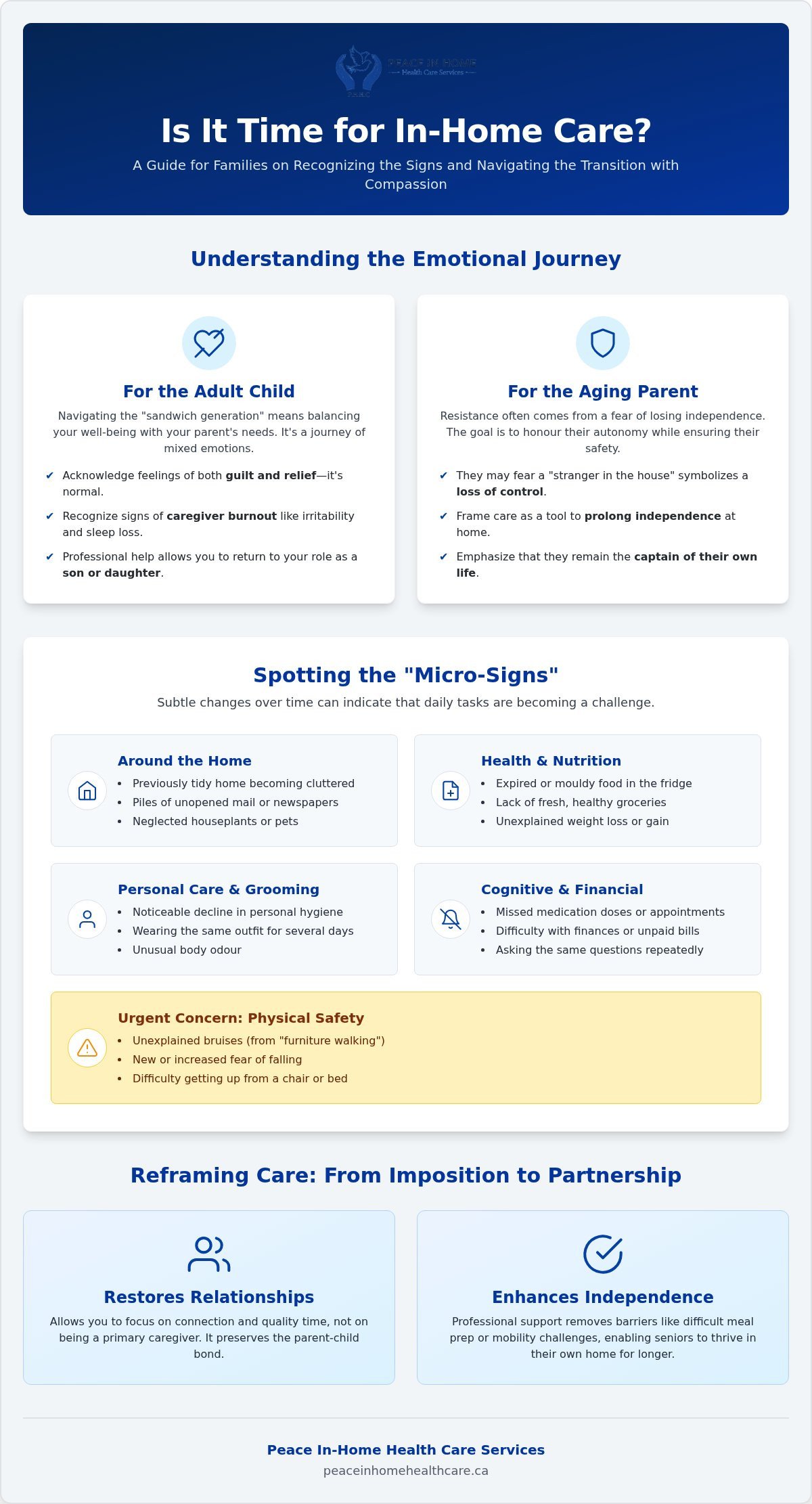
The decision to bring support into a family home is rarely a single, clear moment. Instead, it’s often a slow realization built on late-night worries and the heavy feeling that things are slipping. When you begin transitioning parent to in-home care, you aren’t just checking off a list of tasks. You’re navigating a profound shift in the family dynamic. It’s normal to feel a confusing surge of relief mixed with sharp stabs of guilt. You might feel like you’re failing to do it all yourself, while your parent might see a “stranger in the house” as the first step toward losing their autonomy entirely.
In 2026, the most successful care models have moved away from clinical, rigid schedules. A successful transition relies on a human-first approach that prioritizes the person’s history, preferences, and emotional comfort over a simple checklist. We view this as a care partnership rather than a care imposition. It is a collaborative effort where your parent remains the captain of their own life, supported by a reliable and attentive crew.
Navigating the Guilt of the “Sandwich Generation”
Living in the GTA often means balancing a demanding career with the needs of growing children and aging parents. This “sandwich” effect creates immense pressure that can quickly lead to burnout. You might feel you should be the one helping with every meal or bath, but professional support is an act of love, not a failure of duty. It’s a way to protect the quality of your relationship.
Choosing an expert allows you to return to your most important role: being a son or a daughter. When you aren’t exhausted by the physical demands of caregiving, you have the emotional space to actually enjoy the time you spend together. Professional help doesn’t replace you; it sustains you.
Reframing Care as a Tool for Independence
Many seniors resist help because they view it as an admission of defeat. We choose to see it as the fuel that allows a senior to stay in the home they love for much longer. Professional support removes the barriers that make daily life difficult, such as mobility challenges or complex meal preparation.
By introducing personal care assistance for seniors, sensitive tasks are handled by a respectful professional. This preserves your parent’s dignity and keeps your interactions focused on connection rather than chores. This shift creates a stable, predictable routine that replaces the chaos of “just getting by” with genuine peace. It turns the home back into a sanctuary instead of a place of struggle.
Identifying the Right Moment: Signs Your Parent Needs Support at Home
It’s rarely a single, dramatic event that signals the need for help. Most often, the indicators are “micro-signs” that appear slowly over several months. You might notice a previously tidy home in North York starting to feel cluttered, or perhaps your parent is wearing the same outfit several days in a row. These changes in household cleanliness and personal grooming often suggest that daily chores have become physically or mentally taxing. When you begin the process of transitioning parent to in-home care, paying attention to these subtle shifts allows you to intervene before a safety risk occurs.
Nutrition is another critical barometer of well-being. Open the fridge during your next visit; expired milk, mouldy produce, or a lack of fresh food can indicate that grocery shopping or meal preparation has become too difficult. Unexplained weight loss is a significant red flag that requires attention. Similarly, cognitive health should be monitored through daily patterns. Look for missed medication doses, unopened bills piling up on the counter, or a tendency to ask the same question multiple times within a single conversation.
Physical safety remains the most urgent concern. Unexplained bruises on the arms or legs often suggest “furniture walking,” where a senior uses tables and chairs to steady themselves because they’re losing balance. A growing “fear of falling” is equally telling. If your parent has started avoiding the stairs or refuses to leave the house for short walks, their world is shrinking due to a lack of confidence in their mobility.
The Red Flags of Caregiver Burnout
Your own health is a vital part of this equation. If you find yourself feeling constantly irritable, losing sleep, or neglecting your own career and family obligations, you’re likely experiencing burnout. It’s essential to prioritize preventing caregiver burnout Toronto by introducing professional support before you reach a breaking point. Waiting for a crisis, such as a fall or a medical emergency, makes the transition much more frantic and stressful. Taking these steps early makes transitioning parent to in-home care a proactive choice rather than an emergency response.
Specialized Signs for Dementia and Alzheimer’s
When memory loss is involved, the signs are often more complex. You might see subtle personality changes, such as a normally social parent becoming withdrawn or uncharacteristically suspicious of neighbours. Safety risks escalate quickly if they begin wandering or forgetting to turn off the stove after tea. Sundowning is a phenomenon where seniors experience increased confusion, anxiety, and agitation as daylight fades, often signaling a need for structured support during the evening hours. If you’re noticing these changes in your loved one, it may be time to speak with a compassionate guide to discuss a tailored care plan.
Home Care vs. Retirement Residences: Evaluating the Best Fit for Your Family
When families begin the process of transitioning parent to in-home care, they often feel pressured to choose a retirement residence as the “default” next step. However, for many seniors in the GTA, staying home is not just a preference; it’s a strategic health choice. Facilities often require high, fixed monthly fees regardless of how much individual interaction your parent actually receives. In contrast, home care services for seniors Toronto offer a flexible model that scales based on actual needs. You pay for the support required, whether that is a few hours of help with morning routines or dedicated assistance throughout the night.
Beyond finances, the one-on-one attention provided at home is unmatched. In a facility, staff ratios mean your parent is one of many residents competing for a caregiver’s time. At home, the caregiver’s entire focus is on your parent’s safety, dignity, and comfort. For those living with memory loss, the familiarity of their own kitchen or living room provides a grounding effect. This continuity significantly reduces the confusion and “transfer trauma” often triggered by moving into a new, clinical environment.
The Value of Aging in Place in the GTA
There is a deep psychological comfort in remaining within a beloved community like Richmond Hill or Oakville. Transitioning parent to in-home care allows them to keep their morning coffee ritual on their own porch and maintain ties with long-term neighbours. These social threads are vital for emotional health. Our companionship care for seniors Toronto ensures that urban isolation does not take hold. Having a friendly, familiar face for walks in the local park or meaningful conversation in the garden helps maintain a sense of purpose and belonging.
Skilled Nursing: Bringing the Clinic to the Living Room
Families often believe that complex medical needs automatically require a nursing home. Modern skilled nursing care at home Toronto changes that narrative. Whether it is managing chronic conditions or assisting with post-hospital recovery, professional nursing can happen in a private, quiet setting. Recovery is often faster when a patient is in their own bed, away from the noise and infection risks of a hospital ward. For those requiring constant supervision, 24/7 live-in care serves as a dignified, reliable alternative to institutional settings, ensuring your parent receives high-level medical support in the place they feel most secure.
A Step-by-Step Plan for a Smooth Transition to Professional Support
Success in transitioning parent to in-home care isn’t about speed; it’s about stability. A rushed introduction often leads to resistance, while a methodical plan builds a foundation of trust and respect. It’s essential to realize that this is a process of negotiation, not a one-sided decision. By following a structured approach, you can reduce the emotional friction for everyone involved.
A methodical plan typically includes these five foundational steps:
- Step 1: Conduct a “Family Meeting.” Ensure siblings and spouses are on the same page regarding care goals and budget. Conflicting messages from family members can create unnecessary anxiety for a senior who is already feeling vulnerable.
- Step 2: Broach the subject with your parent. Use “I” statements and focus on safety. Transitioning parent to in-home care is much smoother when they feel the decision is being made with them, not for them.
- Step 3: Start small. Begin with “Respite Care” or “Companionship” to build trust. This allows your parent to get used to a new face without feeling overwhelmed by a full schedule of personal care.
- Step 4: Interview and select a local agency. Choose a provider that aligns with your family’s values and understands the unique needs of GTA neighbourhoods, from the quiet streets of Mississauga to the bustling core of Toronto.
- Step 5: Create a “Care Diary.” Use this to monitor the transition and adjust the plan weekly. Objective notes on mood, appetite, and mobility help you make informed decisions about increasing or decreasing support.
Conversational Scripts for the “Difficult Talk”
One of the biggest hurdles is avoiding the “parenting the parent” trap. Your role is to be a supportive partner, not a manager. It’s vital to speak with respect and honour their autonomy. When handling the “I don’t want a stranger here” objection, use the “Introduction Phase” strategy. You might say: “I want to make sure you can stay in this house as long as possible, and I think some extra help with the heavy lifting will make that happen.” This reframes the caregiver as a tool for independence rather than a sign of decline.
The “Slow-Start” Strategy
Resistance often melts away when the change feels manageable. Starting with just four hours of companionship a week is an excellent icebreaker. During these early visits, the caregiver can focus on activities for dementia patients at home, such as sorting old photos or light gardening. These engaging moments build a genuine bond that isn’t based on medical needs. Over time, as trust grows, you can naturally transition from social visits to more intensive personal care assistance without causing distress.
How Peace In-Home Health Care Supports Your Family’s Transition in Toronto and the GTA
Peace In-Home Health Care Services has spent over 17 years acting as a trusted guide for families throughout the Greater Toronto Area. We realize that transitioning parent to in-home care is a deeply personal experience that requires more than just technical skill. It requires a partner who understands the local landscape and the emotional nuances of aging in place. Our approach is built on the belief that every senior deserves to be treated with the same dignity and respect we would want for our own parents.
One of the ways we ensure a smooth start is through our personalized matching process. We don’t just look at a schedule; we look at personalities. We aim to find a caregiver whose temperament and interests align with your parent’s, turning a “stranger in the house” into a welcome companion. During the critical first 30 days, your dedicated Care Manager acts as a stable hand. They provide the oversight and adjustments needed to ensure the care plan is working perfectly, giving you the peace of mind to step back into your role as a loving family member.
Tailored Care Plans for Every Neighbourhood
Our reach extends across the major hubs of the GTA, including Vaughan, Markham, and Mississauga. We believe that local caregivers provide a unique advantage because they understand the specific pulse of these communities. Whether your parent is used to the quiet residential streets of Oakville or the vibrant atmosphere of downtown Toronto, our caregivers help them maintain their familiar routines. Being a local agency also means we can respond quickly to changing needs, providing a level of reliability that larger, national corporations often struggle to match.
Our Commitment to Professional Excellence
The safety of your loved one is our highest priority. Every one of our personal support workers (PSWs) undergoes a rigorous vetting and training process to ensure they meet our high standards of care. We don’t operate in a vacuum; instead, we integrate seamlessly with your parent’s existing medical teams and your family’s established routines. This collaborative approach ensures that the care provided is consistent, professional, and attentive to every detail. You don’t have to do this alone. We are here to guide you through every step of this transition with kindness, patience, and expert care.
Restoring Peace and Dignity to Your Family Home
Choosing to introduce professional support is a profound act of love that restores the natural bond between you and your parent. By identifying the subtle micro-signs of decline early and choosing the path of aging in place, you honour their personal history while ensuring their physical safety. The process of transitioning parent to in-home care allows your loved one to stay in the GTA neighbourhood they’ve spent a lifetime in, surrounded by familiar comforts and memories.
With over 17 years of trusted service throughout Toronto, Vaughan, and Markham, we specialize in providing tailored dementia and Alzheimer’s support that prioritizes individual dignity. Our care managers act as a reliable guide, offering a stable hand during the first month and beyond. We’re committed to creating a personalized environment where your parent can thrive with attentive, professional assistance that respects their independence.
You don’t have to carry this weight alone. We’re ready to walk alongside you to ensure your parent’s golden years are filled with comfort, respect, and genuine peace for the entire family.
Frequently Asked Questions
How do I know if my parent is safe living at home alone?
Safety is determined by their ability to manage daily tasks without risk of injury or neglect. Look for frequent falls, forgotten stove burners, or an inability to manage complex medications. If they are “furniture walking” or seem fearful of stairs, their safety is likely compromised. A professional assessment can help identify specific environmental risks in their GTA home that tailored support can mitigate, ensuring they remain secure in their own space.
What if my parent refuses to allow a caregiver into the house?
Resistance is a natural response to the fear of losing independence. Instead of forcing the issue, reframe the caregiver as a “personal assistant” or someone to help with heavy chores like laundry. Start with a non-medical role like companionship or light housekeeping to build rapport first. Transitioning parent to in-home care is often more successful when the introduction is gradual and focused entirely on their specific comfort levels and personal boundaries.
Is in-home care in Toronto covered by OHIP or private insurance?
While OHIP provides some funded hours through Ontario Health atHome, these are often limited and based on strict eligibility assessments. Many GTA families supplement public support with private care to ensure consistent quality and frequency of visits. Most private insurance plans cover “skilled nursing” or “personal care,” but it’s essential to verify your specific policy details with your provider. We can help provide the necessary documentation and care plans required for your insurance claims.
How often should I visit my parent once professional care has started?
Your visits should focus on maintaining your emotional connection rather than performing chores. Since professional support handles the physical tasks like meal prep and cleaning, your time together can be spent on meaningful conversation. Many families find that visiting two or three times a week is ideal for monitoring the transition while allowing the caregiver and parent to establish their own routine. Quality of connection always matters more than the number of hours spent.
Can we start with just a few hours of home care per week?
Yes, starting with a few hours of companionship or respite care is a recommended way to ease into the transition. This “slow-start” approach helps your parent adjust to a new person in their space without feeling overwhelmed. It allows trust to build naturally over several weeks. As their needs evolve or they become more comfortable, you can easily scale the hours to include more intensive personal care, mobility assistance, or medication reminders.
What is the difference between a PSW and a registered nurse for home care?
Personal Support Workers (PSWs) focus on daily living activities, while Registered Nurses handle complex medical tasks. A PSW assists with bathing, dressing, meal preparation, and light housekeeping. A registered nurse provides skilled nursing care, such as wound management, administering injections, or monitoring chronic medical conditions. Most care plans in the GTA utilize a combination of both roles to ensure that all physical, social, and medical needs are met comprehensively and safely at home.
How do you handle transitions for parents with advanced dementia?
Transitions for dementia patients require a high degree of patience, consistency, and specialized communication techniques. We focus on maintaining familiar routines to reduce confusion and anxiety. Our caregivers are trained specifically in dementia and Alzheimer’s care, using person-centered strategies to manage symptoms like sundowning. By introducing the same caregiver consistently, we create a sense of safety and recognition for the senior during the sensitive process of transitioning parent to in-home care in their familiar environment.
What areas of the GTA do you provide home care services in?
We provide comprehensive home care services across the primary hubs of the Greater Toronto Area. Our team serves families in Toronto, Vaughan, Markham, Mississauga, and Richmond Hill. Because we are a local agency, our caregivers are familiar with these specific communities and can respond reliably to your family’s needs. This local presence ensures that we can provide attentive, personalized support regardless of where your family home is located in the region.