

What if the conversation you’re most afraid of having is actually the greatest gift you could give your parents to help them stay right where they want to be? You likely feel a heavy weight of guilt or worry that suggesting help will feel like taking away their freedom. It’s completely natural to feel anxious about how to talk to parents about in-home care, especially when you want to protect their dignity and avoid a painful argument.
You aren’t alone in this journey. We understand that you want the best for your family, but you can’t do everything yourself without risking your own well-being. This guide will show you how to navigate these sensitive waters with empathy, ensuring your parents feel heard rather than managed. We’ll help you frame support as a way to preserve their independence while giving you the peace of mind you deserve.
We’ll explore practical communication strategies, look at helpful Canadian resources like the Ontario Seniors Care at Home Tax Credit, and discuss how to introduce a supportive companion into their daily routine without the friction. By the end, you’ll have a clear, low-stress path forward that prioritizes your parents’ safety and your family’s harmony.
Key Takeaways
- Understand the core fears driving resistance, including the loss of privacy and autonomy, so you can approach your parents with deeper empathy and patience.
- Learn how to talk to parents about in-home care by replacing high-pressure meetings with a series of gentle, informal chats focused on their personal goals.
- Master the art of asking open-ended questions that empower your parents to identify their own needs and maintain their sense of control over their daily lives.
- Discover compassionate ways to reframe common objections, such as the fear of strangers, by highlighting the benefits of a supportive and dignified companion.
- Identify the essential steps for transitioning to support in the GTA, including how to find a reliable agency that prioritizes personalized care plans and rapport.
Understanding Why Parents Resist the Idea of In-Home Care
When you first consider how to talk to parents about in-home care, you might expect them to welcome the support with open arms. Instead, you often face a “no” that feels like a brick wall. This resistance isn’t just about being difficult; it’s a deeply rooted psychological defense of their life’s work. For many seniors, their home is a symbol of their competence and identity. Accepting help feels like admitting a personal failure rather than utilizing a helpful resource that could improve their quality of life.
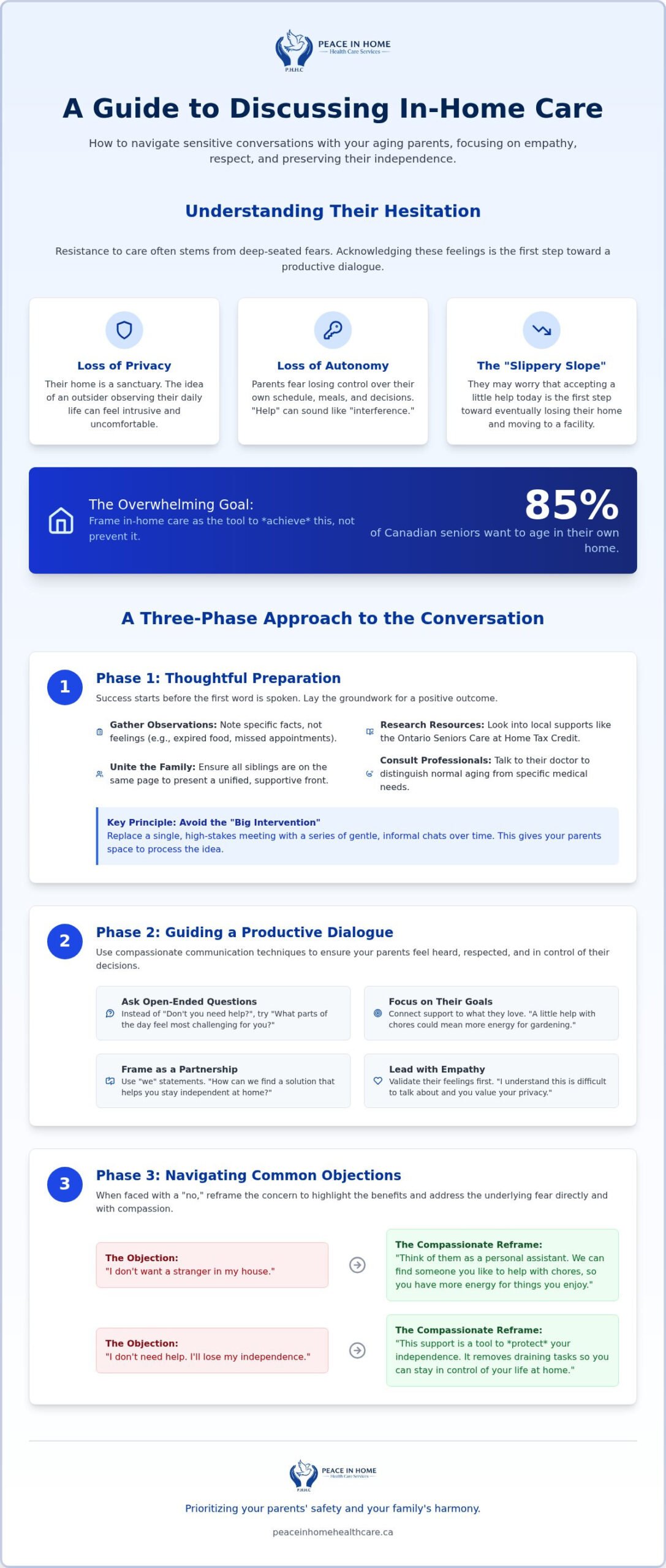
There are three core fears that drive this pushback. First is the loss of privacy. Their home is a sanctuary where they’ve lived for decades without outside observation. Second is the loss of autonomy, or the fear that they’ll no longer be the boss of their own schedule. Finally, there’s the “slippery slope” anxiety. They worry that agreeing to a little help with meal preparation today means they’re on an inevitable path to a nursing home. Understanding What is in-home care? helps reframe this; it’s actually a strategic tool designed to prevent that very outcome. Surveys consistently show that 85% of Canadian seniors prefer ageing in place over moving to a care facility.
The Fear of Losing Independence
To a parent who has managed a career and raised a family, “help” can sound like “interference.” The family home is often the last place where they feel completely in control. When you suggest support, they may hear a critique of their abilities. It’s essential to validate their desire for independence. You can acknowledge their strength while gently pointing out that some tasks are now stealing their energy. The goal is to show that support isn’t about taking over their life; it’s about removing the burdens that make staying at home difficult. This approach shifts the focus from what they can’t do to how they can keep doing what they love.
The “Stranger in the House” Barrier
Inviting a new person into a private space creates natural anxiety about security and comfort. This is why professional care focuses so heavily on personality matching. A caregiver shouldn’t feel like a “guard” or a “medical monitor” watching their every move. Instead, they are a supportive companion or a personal assistant. They handle the chores or the heavy lifting so your parents can focus on what they actually enjoy, like gardening or visiting with neighbours. This shift in perspective helps turn a “stranger” into a reliable partner in their daily routine, maintaining the familiar lifestyle they’ve worked so hard to build.
Preparing for the Conversation: The “Before” Phase
Successful communication starts long before you sit down at the kitchen table. When learning how to talk to parents about in-home care, the most important rule is to avoid the “Big Intervention.” A single, high-stakes meeting often feels like an ambush to a senior, triggering the defensive responses discussed earlier. Instead, think of this as a series of gentle, low-pressure conversations that unfold over weeks or even months. This gradual approach allows your parents to process the idea of support at their own pace.
Before you begin, it’s wise to consult with professionals who understand the local landscape. Speaking with a doctor or a provider of skilled nursing care at home Toronto can help you distinguish between normal ageing and specific medical needs. You can also review Ontario’s guide to programs and services for seniors to understand what government supports might be available to supplement private care. Finally, ensure you and your siblings are on the same page. A unified family front prevents your parent from feeling like they can “play” one child against another, which only adds to the stress of the transition.
Gathering Your Observations
To keep the conversation productive, you need to rely on facts rather than feelings. It’s much harder to argue with objective evidence than a vague sense of worry. Start keeping a quiet log of specific incidents that suggest a need for support. Are there expired cartons of milk in the fridge? Has the garden they usually love become overgrown? Using a checklist of signs your parent needs home care can help you stay focused on safety and health. When you speak, use “I” statements like, “I feel worried when I see the stairs are becoming difficult for you,” rather than “You can’t handle the stairs anymore.” This keeps the focus on your love and concern rather than their perceived failings.
Setting the Scene for Success
The environment where you talk matters as much as what you say. Choose a “neutral” time when everyone is well-rested; for many seniors, mornings are better than late afternoons when fatigue or “sundowning” might set in. The kitchen table is often the best spot because it feels familiar and safe, unlike a noisy restaurant or a clinical doctor’s office. Identify which family member has the strongest rapport with your parent to lead the chat. If you’re feeling overwhelmed by where to start, you can always reach out for a gentle consultation to help organize your thoughts before the first conversation begins.
5 Principles for a Productive Dialogue with Aging Parents
Once you’ve prepared your observations, the next step is the actual conversation. Knowing how to talk to parents about in-home care requires a shift from being a “solver” to being a “supporter.” Your goal isn’t to win an argument; it’s to build a bridge toward a safer, more sustainable lifestyle. By following these five principles, you can keep the dialogue respectful and productive.
- Principle 1: Ask, Don’t Tell. Use open-ended questions like, “What parts of the day are feeling the most tiring lately?” This allows them to lead the discovery of their own needs and honours their perspective.
- Principle 2: Focus on Goals. Frame care as a tool to help them achieve what they value. If they love hosting family, explain how support can keep those traditions alive. This aligns with the National Advisory Council on Aging’s report on mental health, which emphasizes the importance of maintaining social roles for emotional well-being.
- Principle 3: Offer Choices. Anxiety often stems from a lack of control. Give them the final say on the details. Ask if they’d prefer a morning or afternoon visit, or which specific tasks they want to delegate first.
- Principle 4: Start Small. You don’t have to commit to 24/7 care immediately. Suggesting a “trial period” or a specific task like meal preparation makes the change feel manageable rather than overwhelming.
- Principle 5: Make Them the Project Manager. Ensure your parents feel like the boss of their own care plan. They should be the ones to interview the caregiver and decide if the “personality match” feels right.
Conversational Scripts to Get Started
If you’re unsure of the exact words to use, these scripts can help break the ice. They focus on empathy and “I” statements to avoid triggering defensiveness.
“Mom, I’ve noticed you’re more tired lately after doing the laundry. I want to make sure you have enough energy for your garden. What if we found someone to handle the heavy chores so you can focus on the things you actually enjoy?”
“Dad, I want to make sure you can stay in this house as long as possible. If we bring in a little help now, it might prevent a fall or an injury that could force a move later. Can we talk about what that might look like?”
“I’m having a hard time keeping up with everything between work and my own kids, and I feel like I’m rushing when I visit you. I need a little help so I can go back to being your daughter instead of your errand-runner. Would you be open to trying a companion for a few hours a week?”
The Power of the “Trial Period”
One of the most effective ways to lower resistance is to frame the change as a “test drive” rather than a permanent contract. It’s much easier for a parent to agree to a two-week trial than to “in-home care” as a broad, forever concept. Using respite care Toronto services is a perfect way to introduce support as a temporary measure to see how it feels. Set a specific date on the calendar to sit down together and decide if the arrangement is working. This keeps the power in their hands and makes the first step feel safe and temporary.
Overcoming Common Objections with Care and Empathy
Even with a gentle approach, you may still encounter a firm “no.” Resistance is rarely about stubbornness; it’s often a protective shield against the fear of change. When you’re learning how to talk to parents about in-home care, it helps to view these objections as opportunities to understand their worries more deeply. Instead of pushing back with logic, try to realize the emotion behind their words. If they say, “I don’t want a stranger in my house,” they’re likely expressing a need for safety and privacy. You can validate this by explaining that we don’t want a stranger either; we want to find a supportive companion who feels like a natural extension of the family.
For families where there is cognitive decline or Alzheimer’s involved, the objections can be more complex. A parent may not realize they are missing medications or forgetting to turn off the stove. In these cases, avoid arguing over the facts. Instead, focus on the activity or the relationship. Rather than saying they “need a nurse,” suggest that a companion is coming over to help with a specific project or to share a meal. This preserves their dignity while ensuring their safety is quietly managed in the background.
The “For My Peace of Mind” Strategy
When a parent insists they are “perfectly fine,” it can be helpful to shift the burden of the need from them to you. Many parents who refuse help for themselves will gladly accept it if they believe they’re doing it as a favour for their children. You might say, “I know you’re managing well, but I find myself worrying about you while I’m at work. It would give me such peace of mind to know someone is here to help with the heavy lifting.” This approach reduces their feeling of being a burden and allows them to take on the role of the “helper” who is easing your anxiety.
Addressing the Cost of Care
Financial concerns are a common barrier, especially in the GTA. It’s helpful to frame support as an investment in safety that prevents the much higher emotional and financial cost of a crisis. Proactive home care services for seniors in Toronto are often more affordable and flexible than a sudden move to a residential facility. You should also discuss available supports, such as the Ontario Seniors Care at Home Tax Credit. As of 2026, this credit can cover up to 25% of eligible medical expenses for seniors aged 70 or older, providing up to $1,500 in annual relief for families managing these costs.
Taking the First Step: Transitioning to Support in the GTA
Once you’ve navigated the complexities of how to talk to parents about in-home care, the transition from discussion to action should be handled with the same level of gentleness. Choosing the right partner in the Greater Toronto Area is essential to ensuring the plan you’ve built together actually succeeds. A local agency doesn’t just provide a service; they become a stable presence that understands the unique rhythm of life in Ontario. The goal is to move from the abstract idea of “help” to a tangible, reliable relationship that improves everyone’s quality of life.
The Importance of a Local GTA Partner
Selecting an agency with deep roots in Toronto, Vaughan, and the surrounding regions makes a practical difference in the quality of care. Local knowledge of neighbourhoods like Richmond Hill, Oakville, or Scarborough ensures that logistics, such as travel times and access to community resources, are managed efficiently. A GTA-based coordinator can adjust care plans quickly as your parent’s needs change, ensuring that support remains personalized and relevant. This local expertise provides a layer of reliability that is vital during a time of transition, giving you the confidence that a professional team is always nearby.
The first meeting between a parent and a caregiver should never feel like a formal inspection. We often recommend a “Social Visit” approach, where the caregiver is introduced as a supportive companion coming by for a coffee or a chat. This low-pressure introduction allows rapport to build naturally before any specific tasks begin. An in-home assessment is a key part of this process; it’s a time for us to listen to your parent’s stories and preferences, ensuring they feel respected as the primary decision-maker in their own home.
Your Next Steps with Peace In-Home Health Care
At Peace In-Home Health Care Services, we’ve spent over 17 years helping families across the GTA find the right balance of support and independence. Our compassionate intake process starts with listening to your family’s unique story. We don’t believe in one-size-fits-all solutions; instead, we create tailored care plans that respect individual routines and preserve the dignity of every senior we serve.
We take great care in matching caregivers based on personality as well as specialized skills, such as dementia care. This ensures that the person entering your parent’s home isn’t just a provider, but a trusted guide who understands their specific needs. You don’t have to navigate this journey alone. We are here to stand alongside your family, providing the steady hand and expert navigation needed to ensure your parents can age in place with the security and peace of mind they deserve.
Empowering Your Family’s Path Forward
Approaching the topic of support is one of the most significant acts of love you can offer your parents. By leading with empathy and understanding the fears behind their resistance, you can transform a difficult conversation into a collaborative plan. Mastering how to talk to parents about in-home care isn’t about winning an argument; it’s about ensuring they remain the authors of their own lives in the comfort of their own homes.
With over 17 years of dedicated service in the GTA, Peace In-Home Health Care Services understands the delicate balance of providing safety while respecting dignity. Whether you need expert support for dementia and Alzheimer’s or personalized care plans tailored to your family’s unique routine, we are here to provide a steady hand. You don’t have to carry the weight of caregiving alone. Starting small can lead to a lasting sense of peace for everyone involved.
Take a deep breath and know that by seeking help, you are protecting both your parents’ independence and your relationship with them. We look forward to being your trusted guide in creating a safe, dignified, and joyful environment for your loved ones.
Frequently Asked Questions
What is the best way to start a conversation about home care?
The best way to start is through a series of small, informal chats rather than a single high-pressure meeting. Begin by mentioning specific, gentle observations, such as noticing they seem more tired after grocery shopping or doing the laundry. This gradual approach prevents your parents from feeling ambushed and allows them to process the idea of support at their own pace without feeling defensive.
What if my parents flatly refuse any help at home?
If your parents refuse help, try shifting the focus to your own well-being using the “peace of mind” strategy. Explain that having someone come in for light housekeeping or meal preparation would help you worry less during your workday. Often, seniors who won’t accept help for themselves are more than willing to do it as a favour for their children to ease their anxiety.
How can I convince my parent that a caregiver isn’t a “stranger”?
You can bridge this gap by introducing the caregiver as a “personal assistant” or a “supportive companion” rather than a medical monitor. We recommend arranging a low-pressure social visit where they can chat over tea before any care tasks begin. Personality matching is a core part of our service, ensuring the individual who enters their home feels like a reliable and dignified extension of the family.
Is it better to talk to my parents alone or with my siblings?
It’s usually best to start the conversation with the one family member your parent trusts most to avoid making them feel “ganged up on.” While you should align with your siblings beforehand to ensure a unified front, a one-on-one chat often feels more dignified and less like an intervention. If the initial talk goes well, other family members can naturally join later discussions.
What are the signs that my parent can no longer live safely without help?
Look for concrete signs like missed medications, expired food in the pantry, or uncharacteristic untidiness in the home. Physical indicators, such as unexplained bruising from minor stumbles or a sudden lack of interest in personal grooming, are also clear signals. When you’re learning how to talk to parents about in-home care, having these objective observations helps keep the conversation grounded in their actual safety needs.
How do I handle the guilt of hiring someone else to care for my parents?
Guilt is a common emotion, but remember that hiring professional support allows you to go back to being a daughter or son rather than just a task-manager. By delegating chores like laundry or medication reminders, you can spend your quality time together focusing on your relationship. Professional care is a reliable resource that protects your own well-being while ensuring they receive attentive, expert support.
Should I involve my parent’s doctor in the conversation about home care?
Involving a family doctor can be very effective because seniors often view medical professionals as neutral, trusted authority figures. If your parent is resistant to your suggestions, a doctor’s recommendation for mobility assistance or skilled nursing care may carry more weight. You can speak to the physician beforehand to share your specific concerns so they can gently raise the topic during a routine check-up.
How do we handle the cost of home care in the Toronto area?
Managing the cost involves looking at both private options and available government support. In Ontario, the Seniors Care at Home Tax Credit provides significant relief for those aged 70 and older, covering up to 25% of eligible medical expenses for families with a net income under $65,000. When exploring how to talk to parents about in-home care, framing these services as a way to prevent a more expensive hospital stay can help clarify the value.