

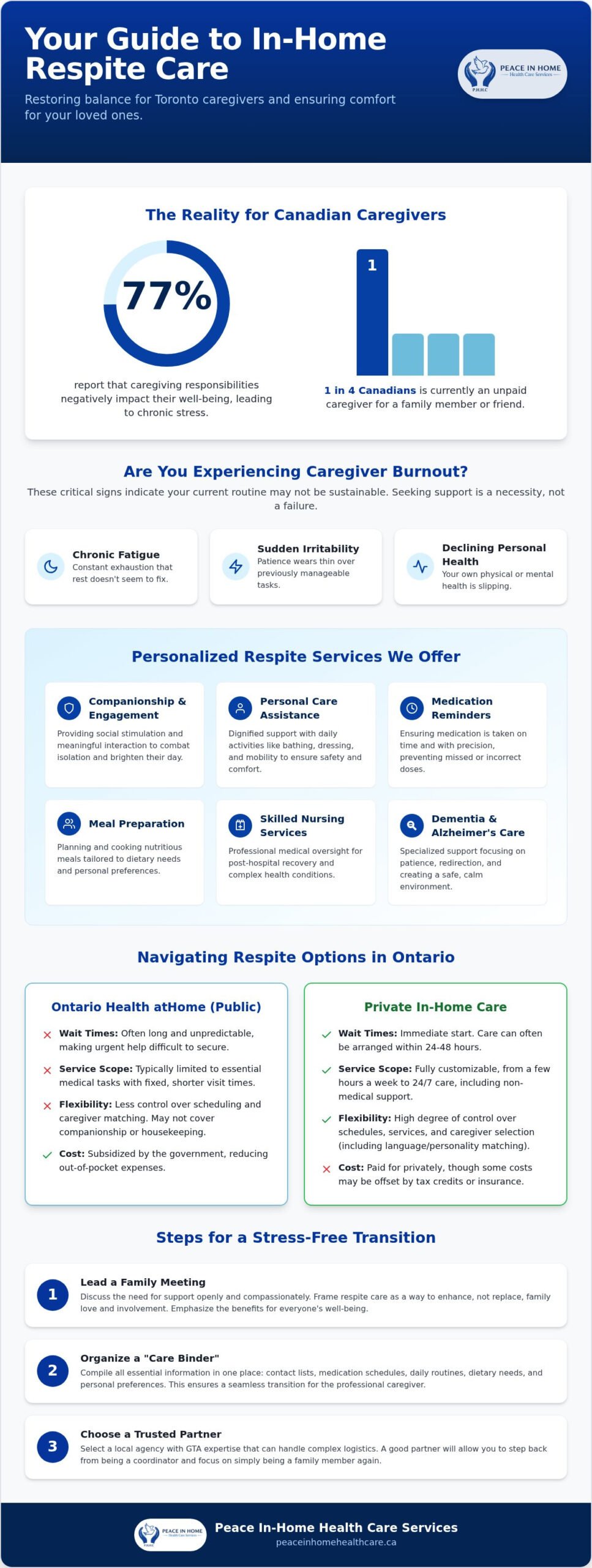
77% of caregivers in Canada report that their responsibilities have had a negative impact on their well-being, leading to chronic stress and exhaustion. If you feel overwhelmed, you aren’t alone, and you certainly haven’t failed. It’s difficult to balance your own life while managing the complex needs of an aging parent or spouse. You likely feel a constant tug-of-war between your deep love for them and your own desperate need for a restful break. Seeking in-home respite care in Toronto is often the most compassionate choice you can make for everyone involved.
This guide will help you move past the confusion of Ontario Health atHome wait times and private options to find a personalized solution that restores your personal energy. We’ll walk through how to access professional support in the GTA, compare the latest 2026 funding programs, and help you organize a sustainable plan that keeps your loved one safe, comfortable, and dignified at home. By the end of this article, you’ll have a clear path forward to reclaim your peace of mind while ensuring your family member receives the attentive, professional care they deserve.
Key Takeaways
- Recognize that professional support is a vital clinical necessity for mental health, helping you avoid burnout while maintaining your loved one’s dignity.
- Learn how to customize a care plan that includes essential services like meal preparation, medication reminders, and specialized dementia support.
- Understand the differences between Ontario Health atHome subsidies and private in-home respite care Toronto options to navigate waitlists and service gaps effectively.
- Discover practical steps for a stress-free transition, including how to lead a family meeting and organize a comprehensive “Care Binder.”
- Identify how a trusted partner with local GTA expertise can handle complex care logistics, allowing you to focus on being a family member again.
Understanding In-Home Respite Care: A Lifeline for Toronto Caregivers
In-home respite care is more than just a temporary break; it’s a strategic pillar of long-term health for both you and your loved one. For a comprehensive definition of respite care, it’s helpful to view it as professional, short-term relief designed to share the heavy responsibilities of caregiving. In a bustling city like Toronto, where the pace of life is demanding, in-home respite care Toronto services provide the space you need to recharge while ensuring your family member stays safe in the comfort of their own home.
One in four Canadians currently acts as a caregiver. In Ontario’s rapidly aging population, many find themselves stretched thin, balancing careers and family life with the needs of a senior. You might feel a heavy sense of guilt for wanting a few hours to yourself, but aging in place successfully requires a team. It isn’t a solo marathon. When you try to do everything alone, the risk of exhaustion increases, which ultimately affects the quality of care your loved one receives. Validating these feelings is the first step toward a more sustainable path.
The Critical Signs of Caregiver Burnout
Burnout doesn’t happen overnight. It creeps in through chronic fatigue, sudden irritability, and a feeling of being constantly on edge. You might notice that tasks that once felt manageable now feel insurmountable. If you find your own health slipping or your patience wearing thin, these are red flags that your current routine isn’t sustainable. This exhaustion can lead to unintentional safety risks for the senior, such as missed medication doses or decreased supervision. To help you identify these patterns early, we’ve created a guide on preventing caregiver burnout Toronto that offers deeper emotional and practical strategies.
Benefits for the Senior: More Than Just a “Sitter”
A professional caregiver brings more than a watchful eye. They offer fresh social stimulation and companionship that can brighten a senior’s day. This interaction is vital for mental health, especially for those living with isolation in various Toronto neighbourhoods. Beyond the emotional boost, respite care focuses on clinical safety. A trained professional can prevent falls, assist with mobility, and manage medication reminders with precision. Our approach is always rooted in a dignified philosophy; we don’t just sit with a client. We engage with them, respecting their routines and personal preferences to ensure they feel valued rather than just supervised. This specialized in-home respite care Toronto families rely on ensures that while you rest, your loved one continues to thrive in a familiar environment.
Personalized Respite Services: Tailoring Support to Your Family’s Needs
Every family’s situation is unique. Effective in-home respite care Toronto must be flexible because the needs of a senior living in North York might differ significantly from those in a busy downtown condo. Professional support isn’t a one-size-fits-all solution; it ranges from a few hours of help each week to 24/7 live-in care. For many families, the journey begins with assistance for daily essentials like meal preparation, light housekeeping, and medication reminders. These services ensure the household continues to run smoothly while you take the time you need to rest and recover.
In a diverse city like ours, we prioritize matching caregivers based on more than just clinical skills. We consider personality and language preferences to ensure your loved one feels truly comfortable. Whether they prefer to speak Cantonese, Italian, or Portuguese, having a caregiver who understands their culture preserves their dignity. For those recovering from a hospital stay, our skilled nursing services provide the medical oversight necessary for a safe transition home. You can find more details on how these services are structured in the official Ontario guide to respite care, which outlines the broad spectrum of support available in the province.
Specialized Dementia and Alzheimer’s Respite
Memory care requires a specific set of skills rooted in patience and redirection. When a senior lives with dementia, their perception of the world changes, often leading to anxiety or confusion. Our caregivers are trained to handle these moments with a gentle touch, focusing on safety for those who may wander. A common challenge for families is “sundowning,” where confusion increases as the sun sets. Utilizing overnight respite care for dementia patients can be a lifeline during these hours, allowing you to sleep soundly while a professional manages any nighttime restlessness or anxiety.
Companionship and Social Engagement
Isolation is a quiet crisis among seniors in the GTA. Professional in-home respite care Toronto providers do more than just supervise; they act as companions. This might involve engaging in a favourite hobby, sharing a conversation over tea, or going for a gentle walk in the neighbourhood. This human-first approach is essential for preventing the cognitive decline associated with loneliness. Our companionship care for seniors Toronto guide explores how these meaningful interactions can improve a senior’s overall outlook on life. If you’re ready to see how a customized plan could help your family, you can speak with a care coordinator to discuss your specific needs.
Navigating Respite Options in Ontario: Public Support vs. Private Care
Finding the right balance of support in Ontario can feel like a full-time job in itself. Most families begin their search with Ontario Health atHome, the provincial organization responsible for coordinating subsidized care. While these public programs are a vital resource, the reality of the system in 2026 is that it’s often overstretched. Publicly funded hours are generally limited to a small window each week, and waitlists for specific subsidies can be quite long. This is why many families find that in-home respite care Toronto services through a private provider are necessary to bridge the gap between what the province offers and what their family actually needs.
Choosing between public and private care doesn’t have to be an “either-or” decision. Many families in the GTA successfully use a hybrid model. They utilize the few hours of government-funded personal care available and supplement them with private support for companionship, meal preparation, or overnight stays. This approach ensures a long-term sustainable care plan that doesn’t leave the primary caregiver stranded when public hours run out. If you’re struggling to find your way through these options, the Ontario Caregiver Organization provides a wealth of resources and a 24/7 helpline to help you find local support services.
Understanding the Public Assessment Process
To access provincial funding, a Care Coordinator must visit the home to perform a formal assessment. They look at the senior’s physical health, cognitive status, and the current level of support from family. In the Toronto Central health region, “high-need” status is typically reserved for those with complex medical requirements or significant safety risks. It’s important to realize that the public system focuses primarily on clinical needs like bathing or dressing. Essential lifestyle supports, such as light housekeeping or social companionship, are rarely covered by government funds, which can leave a heavy burden on family members.
The Advantages of Private Respite in the GTA
Private in-home respite care Toronto offers a level of flexibility and control that the public system simply cannot match. There are no waitlists; support can often start immediately, which is crucial if you’re facing a sudden family emergency or a personal health crisis. You have the power to choose specific hours that fit your schedule, whether you need a few hours on a Saturday evening or consistent help every Tuesday morning. This flexibility allows for a much more personalized senior care Toronto experience. One of the greatest benefits is caregiver consistency. Rather than a rotating door of different staff, you can have the same trusted professional visit every time, allowing them to build a deep, meaningful relationship with your loved one.
How to Prepare for In-Home Respite Care: A Stress-Free Transition
Preparation is the secret to a successful and peaceful experience with in-home respite care Toronto. It’s natural for both you and your loved one to feel a bit anxious about a new person entering the home, but a methodical approach can alleviate that stress. By organizing the logistics ahead of time, you create a stable environment where the caregiver can focus entirely on providing dignified, attentive support. Following a structured plan helps everyone involved feel more secure in the new routine.
- Step 1: Conduct a family meeting. Discuss the need for extra help openly. Ensure everyone understands the goal is to support the primary caregiver and enhance the senior’s quality of life.
- Step 2: Prepare a “Care Binder.” This should include medical history, daily routines (like preferred meal times), and emergency contacts. Don’t forget to list small details, such as a favourite television show or how they like their tea.
- Step 3: Organize the home environment. Clear walkways of clutter to ensure safety. Make sure essential supplies, like medication and personal care items, are easily accessible to the caregiver.
- Step 4: Introduce the caregiver slowly. If possible, have the professional visit while you’re still home. Sharing a coffee or a short conversation helps build trust before the first solo session.
- Step 5: Define clear expectations. Outline specific tasks for the respite period, whether it’s meal preparation or light housekeeping, so there’s no confusion about the caregiver’s role.
Addressing Resistance: When Your Parent Says “No”
It’s common for seniors to resist help because they fear a loss of independence. To manage this, try shifting the focus away from their needs and toward yours. You might say, “I’m feeling a bit exhausted lately, and having some help with the laundry and meals would be a huge relief for me.” Framing the professional as a “helper for the family” rather than a “nurse for the senior” often reduces defensiveness. It’s about making them feel like they’re helping you by accepting the support. For more tips on navigating these delicate conversations, read our guide on personal care assistance for seniors.
Safety and Logistics in the Home
Safety is the cornerstone of effective in-home respite care Toronto. Ensure the caregiver is fully briefed on any specific mobility and transfer assistance requirements to prevent falls or strain. Clear, written instructions for medication reminders should be placed in a visible area to ensure accuracy. While our caregivers can assist with light housekeeping to keep the home tidy, it’s helpful to set boundaries. Defining these tasks early ensures the caregiver spends the majority of their time focused on the senior’s well-being and social engagement rather than just household chores.
Choosing Peace In-Home Health Care for Respite Services in the GTA
With over 17 years of experience serving families across the GTA, Peace In-Home Health Care Services has become a trusted guide for those seeking in-home respite care Toronto. We understand that inviting someone into your home is a significant decision that requires a high level of trust. That’s why we focus on more than just filling a schedule; we focus on building meaningful relationships. Our long-standing presence in Toronto, Vaughan, and Markham is built on a foundation of reliability and deep-rooted expertise in navigating the local healthcare landscape.
Every professional in our network undergoes a rigorous screening and training process. We don’t just look for clinical proficiency; we look for a genuine capacity for kindness and patience. This commitment is the core of our “Peace of Mind” guarantee. It’s our promise to you that your loved one will be supported by a compassionate expert who values their dignity and independence as much as you do. Our reliable services extend across the entire region, including dedicated support in Scarborough, North York, and Mississauga.
Our Compassionate Approach to Every Visit
We believe that care is most effective when it feels natural and unforced. To achieve this, we match our caregivers with your loved one based on their unique personality, interests, and cultural preferences. This “human-first” philosophy ensures that every visit is a positive experience rather than a clinical transaction. Whether your family needs gentle companionship or more complex skilled nursing care at home Toronto, we treat your family member with the same attentiveness and warmth we would our own. We advocate for the elderly, ensuring they can age in place with the respect they deserve.
How to Get Started with a Free Assessment
Reclaiming your personal energy and restoring balance to your home starts with a simple, supportive conversation. Our initial consultation is designed to be a low-stress, guiding experience where we listen to your concerns and seek to understand your family’s specific daily routines. We don’t rush you through these important decisions. Instead, we stand alongside you to create a tailored care plan that fits your life and provides a sustainable path forward. By handling the logistics and professional care, we allow you to focus on simply being a family member again.
Contact Peace In-Home Health Care to book your respite assessment today.
Reclaiming Your Peace of Mind While Preserving Their Dignity
Choosing to seek support isn’t about giving up; it’s about ensuring your loved one has a sustainable support network. By understanding the differences between public waitlists and the flexibility of private care, you can build a plan that prevents burnout and keeps your family member safe. Personalized in-home respite care Toronto services provide the professional oversight needed for complex conditions like dementia while offering you the restful space to recharge.
You don’t have to navigate this journey alone. Our team is ready to stand alongside your family, offering a steady hand and the professional reassurance you need to move forward with confidence.
With over 17 years of experience serving Toronto, Vaughan, Markham, and Mississauga, our specialized dementia care experts are here to help you rediscover peace in your home. We look forward to supporting your family with the dignity and kindness you deserve.
Frequently Asked Questions
What exactly is in-home respite care and how does it work?
In-home respite care is a professional service designed to provide temporary relief for family caregivers. It works by having a trained professional visit your home to take over caregiving duties for a set period. This allows you to rest, work, or attend to personal matters while your loved one remains in a familiar environment. At Peace In-Home Health Care Services, we follow a personalized care plan that covers everything from safety supervision to social engagement.
How much does in-home respite care cost in Toronto in 2026?
The cost of in-home respite care Toronto depends on several factors, including the level of care required and the duration of the visits. Specialized services like skilled nursing or dementia support are typically priced differently than standard companionship. While we don’t provide flat rates here, we recommend a personalized assessment to determine a plan that fits your family’s budget. Many families find that private care provides the flexibility they can’t get through the public system.
Is respite care covered by OHIP or Ontario Health atHome?
Respite care isn’t typically covered by OHIP, but Ontario Health atHome coordinates subsidized support for eligible individuals. A Care Coordinator must perform a home assessment to determine if you qualify for government-funded hours. It’s important to realize that public hours are often limited and waitlists for subsidies can be quite long. Many families choose to supplement these public services with private care to ensure their loved one has consistent, reliable support throughout the week.
Can I get respite care for a loved one with advanced dementia?
Yes, we specialize in providing dignified support for seniors living with advanced dementia or Alzheimer’s. Our caregivers are trained in specific techniques like redirection and patience to manage confusion or “sundowning” effectively. Safety is our top priority, especially for those who might wander or experience high anxiety. This specialized in-home respite care Toronto families rely on ensures that even those with complex cognitive needs can remain comfortably and safely in their own homes.
What is the difference between companionship and personal care during respite?
Companionship care focuses on social engagement, hobbies, and emotional well-being to prevent senior isolation. It often includes light housekeeping and meal preparation. Personal care assistance is more hands-on, involving help with activities of daily living like bathing, dressing, and mobility. While companionship brightens a senior’s day, personal care ensures their physical needs and hygiene are managed with dignity. Both services can be combined into a tailored plan that supports the individual’s unique lifestyle and health requirements.
How quickly can I arrange respite care in the GTA for an emergency?
Arranging support through the public system can take several weeks due to the assessment process. However, private in-home respite care Toronto is designed for much faster implementation. While we recommend planning ahead, we understand that family emergencies happen. We strive to respond to urgent requests across the GTA, including Vaughan and Mississauga, as quickly as possible. Our goal is to provide a steady hand during stressful transitions, helping you navigate a crisis without compromising your loved one’s safety.
Do I need to be present while the respite caregiver is in the home?
No, you don’t need to be present during the care visit. In fact, the primary purpose of respite is to give you the freedom to leave the home, run errands, or simply rest. Our caregivers are fully vetted professionals who are trained to handle all aspects of the care plan independently. Whether you’re gone for a few hours or an entire weekend, you can feel confident that your family member is receiving attentive, reliable, and dignified support in your absence.
How do you vet and train your caregivers at Peace In-Home Health Care?
We maintain a rigorous screening process to ensure every caregiver meets our high standards for professional expertise and compassion. This includes background checks, reference verification, and an assessment of their “human-first” approach. With over 17 years of experience in the GTA, we prioritize ongoing training in specialized areas like dementia care and mobility assistance. We only hire individuals we would trust with our own families, ensuring that every caregiver we send into a Toronto home is a reliable and supportive partner.