

Last night, Sarah sat at her kitchen table in North York, staring at a stack of brochures and feeling a heavy weight in her chest. She knew her father needed support to stay in the home he loved, but she couldn’t find a straight answer about the financial reality of his care. Like so many families in the GTA, she was caught between the desire to provide the best for her parent and the fear of hidden costs she couldn’t afford. You might be feeling that same mix of confusion and guilt right now, wondering if you’re missing out on government help or if your budget will even cover the basics.
It’s a stressful position to be in, but you don’t have to manage it by yourself. This guide provides a transparent look at the cost of home care for seniors Toronto families encounter in 2026, offering the professional reassurance you need to make an informed decision. We’ll walk you through the current landscape of private rates, explain exactly what public funding covers, and detail the tax credits available to help offset your expenses. By the end of this article, you’ll have a clear path forward to ensure your loved one remains safe, dignified, and comfortable in their own home.
Key Takeaways
- Understand the vital differences between OHIP-funded support and private services to eliminate confusion over what is actually covered for your loved one.
- Navigate the current 2026 market rates for PSWs and specialized support to accurately estimate the cost of home care for seniors Toronto families need.
- Compare the financial reality of aging in place against GTA retirement residences, including how to avoid common “A La Carte” fee traps.
- Learn how to maximize your care budget by utilizing the Ontario Seniors’ Care at Home Tax Credit and the Disability Tax Credit.
- Discover how personalized care plans ensure you only pay for the specific support required, providing a dignified and cost-effective alternative to facility living.
Understanding Home Care Costs in Toronto: Public vs. Private Options
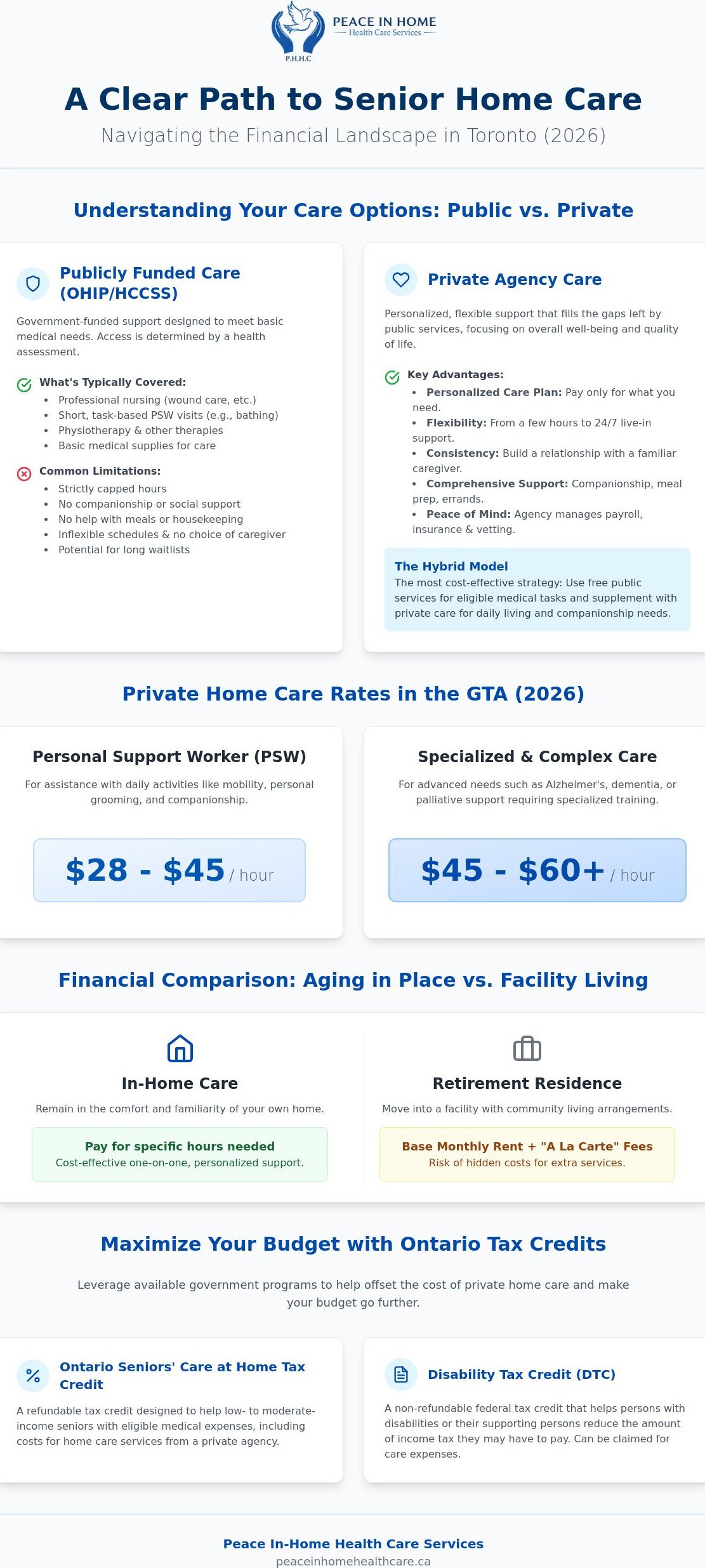
When families begin researching the cost of home care for seniors Toronto, they often start with the public system. In Ontario, home care is managed through Ontario Health atHome, formerly known as Home and Community Care Support Services (HCCSS). This system is funded by the Ontario Health Insurance Plan (OHIP), meaning the services provided are free for those who qualify. However, it’s essential to understand that public funding is designed to meet basic medical needs rather than providing comprehensive, around the clock companionship or lifestyle support.
The reality for many Toronto families in 2026 is that public resources are stretched. While the government has increased investment in community care, waitlists for Personal Support Worker (PSW) visits can still be lengthy. Most families find that the few hours provided by the province aren’t enough to ensure a parent’s safety or to prevent caregiver burnout. This is where private “top-up” care becomes a vital resource, allowing your loved one to maintain their independence without compromising on the quality or frequency of their support.
What OHIP and HCCSS Cover (and What They Do Not)
To access public support, a care coordinator will assess your loved one’s physical and cognitive health. If they qualify, OHIP typically covers:
- Professional nursing for wound care or medication administration
- Short, task-oriented visits from a Personal Support Worker for bathing or dressing
- Physiotherapy, occupational therapy, or speech-language pathology
- Basic medical supplies and dressings related to the provided care
The limitations are often where the stress begins. You cannot choose your specific caregiver, and schedules are frequently dictated by agency availability rather than your family’s routine. Most importantly, public hours are strictly capped. If your parent needs someone to stay overnight or help with meal preparation and light housekeeping, these services usually fall outside the scope of HCCSS.
The Hybrid Care Model: Balancing Public Support with Private Agency Care
Many families find peace of mind by adopting a hybrid model. This involves using publicly funded hours for clinical medical needs while hiring a private agency to handle the daily essentials that make life dignified and comfortable. By integrating home care services for seniors Toronto families can ensure their loved ones have consistent companionship, which public programs simply don’t offer.
Choosing a private partner allows for a personalized approach where the same familiar face arrives at the door every day. This consistency is especially crucial for those living with dementia, where routine is everything. Researching various Elderly care options in Canada shows that staying at home with a tailored support system often leads to better health outcomes. This hybrid approach makes the total cost of home care for seniors Toronto more manageable by leveraging every available public resource before filling the gaps with professional, private expertise.
Hourly vs. Live-in Care: Breaking Down Private Rates in the GTA
Understanding the financial side of private care is often the most daunting part of the journey. In 2026, the market for Personal Support Workers (PSWs) in Toronto has become highly competitive, reflecting both the high cost of living and the specialized skills required for modern senior support. Families typically find that hourly rates for a qualified PSW range between $28 and $45. If your loved one requires specialized support for conditions like Alzheimer’s or palliative needs, these rates often sit at the higher end of the scale, sometimes reaching $60 or more per hour. This premium reflects the advanced training and emotional resilience required to provide dignified care for complex health challenges.
You might be tempted to hire an independent caregiver to reduce the cost of home care for seniors Toronto families face. While a lower hourly rate is appealing, it’s vital to consider the hidden responsibilities of being an employer. When you hire through an accredited agency, the organization manages payroll taxes, WSIB coverage, and rigorous background checks. Most importantly, an agency provides a reliable safety net. If an independent caregiver falls ill or cannot make a shift, the family is often left in a crisis. A professional agency ensures a seamless transition so your parent is never without the support they need to stay safe. When choosing a home care agency Toronto families can trust, verifying these protections should be one of the first items on your checklist.
Factors That Influence Your Hourly Rate
Several variables determine where your specific quote will land within the Toronto market. The first is the level of care required. Basic companionship, which includes meal preparation and light housekeeping, is generally the most accessible option. In contrast, skilled nursing care provided by a Registered Practical Nurse (RPN) or Registered Nurse (RN) commands a higher fee due to the clinical expertise involved in managing complex medical conditions.
Shift duration and geography also play significant roles. Many Toronto agencies apply a small premium for short visits, often under four hours, to account for the caregiver’s travel time across the GTA. With Toronto’s traffic and transit realities, consistency is key. Booking longer, regular blocks of time often makes it easier to secure your preferred caregiver. If you’re feeling overwhelmed by these variables, you can reach out to our team for a personalized discussion about your family’s specific needs.
The Financial Logic of Live-in Care for Seniors
When a senior requires constant supervision to remain safe at home, the “Live-in” model often becomes the most economical choice. Instead of paying for 24 individual hours at an hourly rate, which can quickly exceed $12,000 per month, a live-in professional works for a flat daily rate. In the current 2026 market, this typically ranges from $250 to $600 per day depending on the complexity of the care required.
This model provides incredible consistency, as your loved one builds a deep bond with one or two primary caregivers rather than a rotating team. To make this work, the caregiver must have a private, furnished room and access to meals within the home. It is a beautiful way to maintain a sense of “normalcy” and routine while ensuring professional help is always just a room away. For many families, this stability is the ultimate goal, providing a cost of home care for seniors Toronto solution that balances high-quality support with long-term financial sustainability.
Home Care vs. Nursing Home: A Financial Comparison for Toronto Families
When families begin to look at the cost of home care for seniors Toronto providers offer, they often compare it to the monthly “all-in” price of a retirement residence. On the surface, a facility might seem like a simpler financial choice. However, the reality of assisted living in the GTA frequently involves a complex “A La Carte” fee structure that can catch families off guard. While a base rent might cover a room and meals, the actual support your loved one needs to stay safe and healthy often comes with an additional price tag for every specific task.
One of the most significant differences lies in the level of attention your parent receives. In a typical Toronto retirement home, the staff-to-resident ratio can be as high as 1:10 or even 1:15 during overnight shifts. This means your loved one is competing for attention with a dozen other residents. Professional home care provides a 1:1 ratio, ensuring that a dedicated caregiver is focused entirely on your parent’s safety, medication schedule, and emotional well-being. This personalized focus often prevents the very accidents, like falls or missed doses, that lead to expensive emergency room visits and hospital stays.
The Real Cost of Retirement Homes in 2026
In 2026, the price for independent living in Toronto generally ranges from $3,000 to $5,000 per month. If your loved one requires assisted living, those costs climb to between $4,500 and $6,500, while memory care for dementia often exceeds $8,000 monthly. You should be aware of “hidden” extras that aren’t always in the initial quote. Many facilities charge additional fees for medication management, escorting a resident to the dining room, or even providing an extra wellness check. Before making a decision, it’s helpful to compare home care vs nursing home options to see which model truly fits your family’s budget and care expectations.
The “Emotional ROI” of Staying at Home
There is a profound financial and emotional return on investment when a senior is allowed to age in place. Moving a parent into a facility involves significant relocation costs, the potential loss of home equity, and the emotional toll of leaving a familiar community. When a senior stays in their own home, they maintain their social networks and daily routines, which is proven to lead to better cognitive health and slower physical decline. For families who want to build a long-term strategy around this goal, a comprehensive guide to aging in place in Toronto can provide the detailed planning framework needed to make independence sustainable for years to come.
For family members, the “cost” of not having professional support is often measured in missed work days, chronic stress, and caregiver burnout. Investing in a tailored home care plan provides the stability your family needs. Knowing a reliable professional is present to manage the cost of home care for seniors Toronto families prioritize allows you to return to being a daughter or a son, rather than a full-time care coordinator. This peace of mind is perhaps the most valuable benefit of all.
Maximizing Your Budget: Tax Credits and Financial Assistance in Ontario
Finding the funds to cover the cost of home care for seniors Toronto families require can feel like a daunting puzzle. It’s helpful to realize that you aren’t expected to carry this weight without support. For the 2026 tax year, the Ontario Seniors’ Care at Home Tax Credit remains a cornerstone of provincial relief. This refundable credit covers up to 25% of eligible medical expenses, with a maximum credit of $1,500. While it’s geared toward families with a net income below $65,000, it provides essential breathing room for those balancing the expenses of daily support.
The Disability Tax Credit (DTC) is another powerful tool that often goes underutilized. If your loved one has a prolonged physical or mental impairment, the DTC can provide significant non-refundable relief. Perhaps more importantly, it can sometimes be applied retroactively for up to ten years, offering a much needed financial cushion. When you work with a professional agency, your invoices for personal care and skilled nursing are often eligible medical expenses. Keeping these records organized is vital for maximizing your return and ensuring you receive every dollar of assistance you’re entitled to.
Federal and Provincial Tax Relief for Caregivers
The Canada Caregiver Credit is a federal non-refundable tax credit available to those supporting a spouse or a dependent relative with an impairment. It acknowledges the physical and financial toll that caregiving takes on a family. Additionally, the federal Home Accessibility Tax Credit allows you to claim up to $20,000 in eligible home renovations, such as installing ramps or walk-in tubs, for a credit of up to $3,000. To ensure a smooth experience during a CRA audit, we recommend maintaining a dedicated folder for all care related documents, including:
- Detailed invoices from your home care provider
- Medical certificates or DTC certificates (Form T2201)
- Receipts for home modifications and accessibility equipment
- Travel logs for medical appointments and errands
Alternative Funding: Veterans Affairs and Insurance
If your loved one is a Canadian veteran, they may qualify for the Veterans Independence Program (VIP). This program doesn’t just cover medical needs; it can also help with the cost of home care for seniors Toronto veterans use for housekeeping and grounds maintenance. For those with private long-term care insurance or workplace benefits, it’s worth reviewing your policy for “Skilled Nursing” coverage. Some families also choose to use a Home Equity Line of Credit (HELOC) as a strategic bridge to fund care while keeping their parent in the family home. If you’re unsure which credits apply to your situation, contact our team for a personal consultation to explore your options.
Choosing Peace In-Home Health Care: Transparent, Empathetic Value
Deciding on the right support for a parent is one of the most significant choices your family will ever make. At Peace In-Home Health Care, we understand that the cost of home care for seniors Toronto families budget for isn’t just a line item on a spreadsheet; it’s an investment in your loved one’s comfort and safety. With over 17 years of experience serving the GTA, we’ve helped thousands of families in Mississauga, Vaughan, Scarborough, and beyond find a path that balances high quality support with financial reality. Our long standing presence in these communities allows us to provide a level of reliability and local expertise that newer agencies simply can’t match.
We believe that every senior deserves to age with dignity in the environment they know best. This “human-first” philosophy drives us to create care plans that are as unique as the individuals we serve. Instead of forcing families into rigid, expensive packages, we focus on what’s truly necessary to maintain independence. This tailored approach ensures you aren’t paying for services your loved one doesn’t require, making professional care more accessible than many families initially realize. Whether your parent needs help with daily routines or more complex medical support, we act as your trusted guide through every step of the process.
A Personalized Approach to Senior Care in the GTA
Every journey begins with a conversation. We offer a free in-home assessment to meet your family, understand your parent’s unique personality, and identify their specific health needs. This allows us to craft a plan for personal care assistance for seniors that prioritizes their safety while respecting their autonomy. We don’t believe in a one-size-fits-all model; our scheduling is designed to be completely flexible to fit your life.
Some families only need a professional to check in for a four-hour shift to assist with meal preparation and medication reminders. Others require the comprehensive security of our live-in care for seniors. Regardless of the level of support, our caregivers are chosen for their empathy as much as their clinical skills. This ensures that the cost of home care for seniors Toronto families invest in results in a genuine, supportive relationship that enhances your loved one’s quality of life every single day.
Your Next Steps to Peace of Mind
If you’re feeling overwhelmed by the complexities of senior care pricing or the guilt of not being able to do it all yourself, please know that you don’t have to navigate this transition alone. We invite you to reach out for a transparent, no-obligation consultation. We’ll provide a clear breakdown of how we can support your family and help you maximize the public funding and tax credits we’ve discussed in this guide.
Our goal is to replace your anxiety with a sense of calm and confidence. When you choose a partner with deep roots in the Toronto community and a 17 year track record of excellence, you’re choosing more than just a service. You’re choosing a steady hand and a compassionate expert who will stand by your side. Let’s work together to ensure your parent can stay home safely, surrounded by the memories and comforts they cherish most.
A Clear Path Toward Comfort and Security at Home
Navigating the cost of home care for seniors Toronto families face doesn’t have to be a source of constant stress. By understanding how to blend public funding with private support and maximizing provincial tax credits, you can create a sustainable plan that keeps your parent where they feel most comfortable. The decision to aging in place Toronto seniors choose is a beautiful gift of independence; with the right information, it’s a goal that’s well within reach for your family.
With over 17 years of compassionate care in the GTA, Peace In-Home Health Care is here to act as your trusted guide. Our registered nursing staff and certified PSWs are dedicated to providing the highest standard of support through tailored care plans designed to fit every budget. You don’t have to carry the weight of these complex transitions alone. We’re ready to stand beside you, ensuring your loved one receives the dignified, personalized attention they deserve. To take the first step toward lasting peace of mind, Book Your Free In-Home Assessment Today. Your family’s journey toward a safer, more supportive home life starts with a single, supportive conversation.
Frequently Asked Questions
Is the cost of private home care in Toronto tax-deductible?
Yes, home care expenses are often eligible for the Medical Expense Tax Credit (METC) on your federal and provincial tax returns. You can claim payments made to a private agency for nursing care or personal support services, provided you have the necessary invoices. This credit helps to reduce your overall tax bill, making professional support more affordable for your family.
How much does a Personal Support Worker (PSW) cost per hour in the GTA?
In 2026, the average hourly rate for a professional PSW in Toronto typically ranges between $28 and $45. This rate reflects the high demand for skilled labour in the city and the level of personalized attention required. Specialized care for conditions like Alzheimer’s or palliative needs usually sits at the higher end of this range to account for the caregiver’s advanced training.
Does OHIP pay for 24-hour home care for seniors?
No, OHIP does not fund 24-hour around the clock home care for seniors. While Ontario Health atHome provides free nursing and personal support visits for those who qualify, these services are task-based and limited to a set number of hours per week. Most families who require constant supervision for a loved one choose to supplement these public hours with private agency care.
Is home care cheaper than a retirement home in Ontario?
Home care is often a more budget-friendly option, especially when you leverage a hybrid model of public and private support. While assisted living in a Toronto retirement residence can cost between $4,500 and $6,500 per month, home care allows you to pay only for the specific hours of support your parent needs. This prevents you from paying for facility amenities that your loved one may not use.
Can I get government funding for dementia care at home?
Yes, you can access government-funded support through an assessment by Ontario Health atHome. While this provides a baseline of care, the hours allocated are often insufficient for the 24-hour safety needs of someone living with advanced dementia. Many families use this public funding for medical tasks and hire private agencies to provide the consistent, one-on-one companionship that public programs don’t cover.
What is the Ontario Seniors’ Care at Home Tax Credit?
This is a refundable tax credit designed to assist seniors with low to moderate incomes in managing their medical expenses. For the 2026 tax year, it provides a credit of up to 25% on eligible costs, with a maximum benefit of $1,500. It is a valuable tool for families looking to offset the cost of home care for seniors Toronto providers charge, helping your loved one stay safely in their own home.