

What if the safest place for your parent isn’t a facility with 24-hour staff, but the very living room where they raised you? Deciding between home care vs nursing home is one of the most emotional choices a family can face in 2026. You want to ensure their safety and dignity, but the fear of making the “wrong” choice often leads to sleepless nights and heavy caregiver burnout. With Ontario’s long-term care waitlist now exceeding 50,000 people, the pressure to find a solution that balances comfort, cost, and quality of life has never been higher.
We understand that you’re likely feeling exhausted and confused by shifting healthcare funding and rising costs. You deserve to feel certain that your loved one is protected and respected. This article will help you discover the critical differences between these two paths so you can make a compassionate, informed decision for your family. We’ll break down the latest 2026 Ontario co-payment rates, explore how to maintain independence through personalized support, and provide a clear roadmap to help you realize the best possible outcome for your loved one’s future.
Key Takeaways
- Understand the fundamental differences between tailored 1-on-1 support at home and the structured, communal environment of a long-term care facility.
- Compare the benefits of home care vs nursing home to determine which environment best preserves your loved one’s independence and familiar routines.
- Gain clear insights into Ontario healthcare funding and 2026 co-payment rates to help you budget for private support or public facilities.
- Learn when skilled nursing services at home can safely manage chronic conditions like dementia without the need for an institutional move.
- Use a supportive decision-making framework to alleviate caregiver guilt and find a reliable path forward that prioritizes your family’s emotional well-being.
Home Care vs. Nursing Home: Defining the Best Path for Your Family
The decision to transition a parent or spouse into a new care model is never easy. It’s a choice that balances their medical safety with their emotional well-being. In Ontario, families often find themselves weighing the benefits of home care vs nursing home support while trying to understand a complex public system. At its heart, this choice is about finding where your loved one will feel most respected and secure.
When you begin exploring long-term care options, the terminology can feel overwhelming. The Canadian healthcare landscape, specifically in Ontario, distinguishes between these two paths through Home and Community Care Support Services (HCCSS). This government body coordinates public funding and assessments. However, the reality of a waitlist that has nearly 50,000 people has led many families to realize that staying at home with professional assistance isn’t just a preference. It’s a practical, dignified necessity that preserves a sense of normalcy during a vulnerable time.
What Is In-Home Health Care?
In-home care is centred on the concept of “aging in place.” It allows seniors to remain in their own residence while receiving tailored support that fits their unique rhythm. This model is highly flexible. It ranges from non-medical help, such as companionship care and meal preparation, to more complex skilled nursing care services. Because the care is one on one, it prioritizes the individual’s dignity and keeps them connected to their community, their pets, and their familiar surroundings. It’s about bringing the care to the person, rather than moving the person to the care. For families looking to plan ahead, our comprehensive guide to aging in place in Toronto outlines the practical steps and local resources available to help seniors remain safely and independently at home.
What Is a Nursing Home (Long-Term Care)?
When comparing home care vs nursing home environments, the main distinction is the shift from a private home to a shared facility. Nursing homes, officially called Long-Term Care (LTC) homes in Ontario, are residential facilities for those who require 24/7 medical supervision and nursing care. These environments are designed for individuals with high-acuity needs who can no longer live safely at home, even with significant professional help. While they offer communal living and organized social activities, the setting is inherently more institutional. Accessing an LTC bed requires a formal assessment by a care coordinator to ensure the individual meets the provincial eligibility criteria for this level of intensive, around-the-clock support.
Comparing Levels of Care: Medical Support vs. Personal Assistance
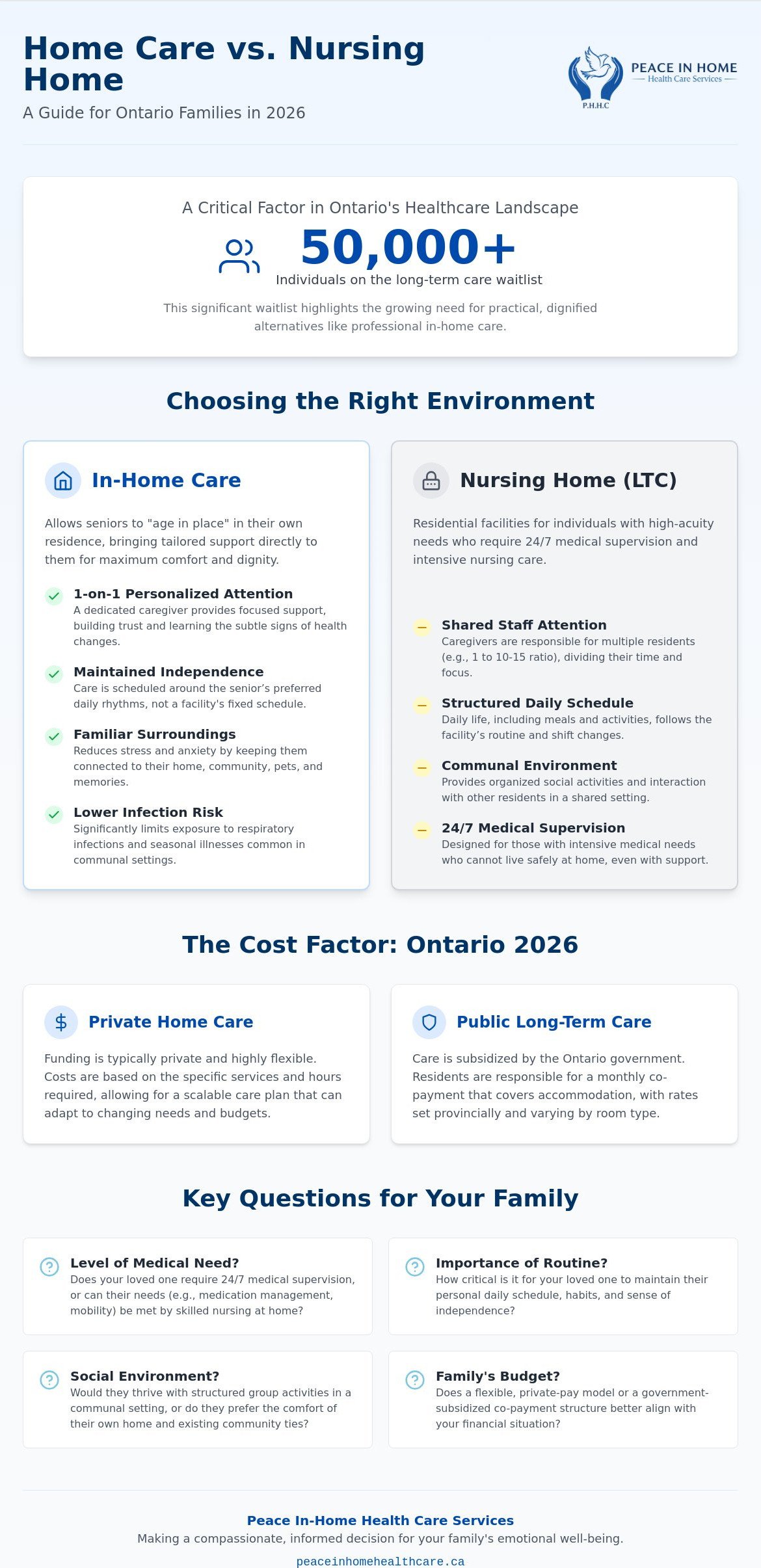
One of the most common worries families have is whether their loved one will receive enough attention. When evaluating home care vs nursing home options, the most striking difference is the ratio of support. In a residential facility, a single staff member may be responsible for ten or fifteen residents at once. In contrast, home care provides a dedicated 1-on-1 relationship. This ensures that your parent isn’t just another room number, but a person whose specific needs and preferences are known and respected every single day.
The Benefits of One-on-One Attention
Personalized attention allows for a level of detail that institutional settings simply cannot match. A consistent caregiver learns the subtle signs of a change in health before they become emergencies. This model offers several distinct advantages:
- Tailored Daily Rhythms: Care is scheduled around the senior’s life, not the facility’s shift changes. If they prefer a late breakfast or an evening walk, their routine remains intact.
- Emotional Security: Seeing the same friendly face every day builds deep trust, which is vital for seniors who may feel anxious about their declining health.
- Health Safety: Communal living environments inherently carry a higher risk of respiratory infections and seasonal illnesses. One-on-one care in a private residence significantly limits exposure.
Specialized Care for Complex Conditions
Many families assume that a nursing home is the only choice for chronic medical issues, but skilled nursing care services can often be delivered safely at home. Whether it’s managing complex medication schedules or providing mobility and transfer assistance, professional support can scale as needs change. However, as medical requirements become more intensive, families must weigh the cost of skilled home care against the communal resources of a facility.
For those living with Dementia or Alzheimer’s, the “human-first” approach of home care is particularly effective. Familiar surroundings provide a “memory anchor” that reduces the confusion and agitation often triggered by a move to an unfamiliar facility. Maintaining a familiar environment helps minimize “sundowning” and allows seniors to navigate their home with greater confidence. Personalized care plans ensure that every individual is treated with the highest level of dignity during end-of-life transitions, focusing on comfort and peace in a setting they love. If you’re unsure which level of support your parent needs, you can speak with our compassionate team to discuss a tailored plan for your family.
Safety is another critical factor. While facilities are built with accessibility in mind, they can be disorienting. At home, fall prevention is personalized. A caregiver focuses entirely on your parent’s specific mobility challenges, ensuring that hallways are clear and assistance is always within reach during transfers. This attentive presence provides the peace of mind that a busy facility staff might not always be able to guarantee.
The Cost Factor: Private Home Care vs. Long-Term Care in Ontario
Financial planning for a parent’s future often feels like a heavy weight on your shoulders. When you’re weighing home care vs nursing home options, it’s vital to look beyond the surface numbers and consider the true value of the support provided. In Ontario, the cost of care is a blend of public funding and personal investment. While the government subsidizes the cost of care in long-term care (LTC) homes, residents are responsible for co-payments for their accommodation. As of July 1, 2026, these rates increased by 2.1% to account for inflation, making the maximum co-payment for basic accommodation $70.00 per day, or approximately $2,129.17 per month.
While that monthly rate might seem straightforward, the hidden costs of a facility often add up quickly. Families frequently face expenses for moving, specialized furniture for smaller rooms, and “extra” service fees for items not covered by the basic rate. There is also a significant emotional toll associated with leaving a family home and losing the independence of a familiar neighbourhood. This is why many families in the Greater Toronto Area view private home care as a superior investment in their loved one’s quality of life and dignity. To get a transparent breakdown of what families in the GTA actually pay, see our detailed guide on the cost of home care for seniors Toronto families encounter in 2026.
Navigating Ontario Healthcare Funding
Understanding what OHIP covers is the first step toward making a confident decision. Ontario’s Home and Community Care Support Services (HCCSS) provides some funded hours for personal support and nursing, but these are often limited. With the provincial waitlist for a long-term care bed now reaching nearly 50,000 people, private home care has become a vital bridge. It allows seniors to receive professional support immediately while remaining in their own residence. Additionally, eligible seniors should look into the Ontario Senior Homeowners’ Property Tax Grant, which can provide up to $500 to help with the costs of staying in their own home. Families who want to take a proactive approach to aging in place in Toronto will find that planning early — including understanding available grants and home modification supports — can make a meaningful difference in long-term affordability. Exploring these long-term care options early helps ensure you aren’t forced into a rushed decision during a health crisis.
Evaluating the Value of Your Investment
When you choose home care, you aren’t just paying for a service; you’re paying for flexibility. Unlike a facility with fixed monthly fees, home care is scalable. You can start with a few hours of companionship or respite care and increase support as needs change. This “pay-for-what-you-need” model ensures that your budget is used efficiently to prioritize your parent’s safety and comfort. For a deeper look at budgeting for these services, see our guide on Managing Home Care Costs for Seniors in the GTA.
Ultimately, the “lifestyle” value of staying in a home full of memories is difficult to quantify. Home care preserves the daily rituals that define a person’s identity, from the morning tea in a favourite chair to the evening walk in a familiar garden. For many, the peace of mind that comes with seeing a parent thrive in their own space is the most valuable outcome of all.
Pros and Cons: A Decision-Making Framework for GTA Families
Every family eventually reaches a crossroads where the current care plan needs a change. When you’re evaluating home care vs nursing home options, it helps to look at the practical trade-offs through a lens of dignity and safety. Home care offers the ultimate advantage of maximum independence. Your loved one keeps their own keys, their own garden, and their own customized routines. The main challenge is the logistics. It requires you to coordinate home maintenance and potential safety modifications, such as installing grab bars or ramps, to ensure the environment remains suitable as mobility changes.
Nursing homes provide the reassurance of immediate, 24/7 access to medical staff. This can be a significant relief for families managing high-risk conditions that require clinical monitoring. The trade-off is often a loss of privacy and a shift to rigid institutional schedules. Meals, baths, and social activities happen on the facility’s clock, not the senior’s. For many families in Toronto and the surrounding areas, a “middle path” has emerged: 24-hour live-in care. This model provides facility-level safety and around-the-clock supervision while allowing the senior to stay in their cherished environment.
When is Home Care the Right Choice?
This path is often the best fit when a senior remains cognitively aware but needs physical help with daily tasks. It’s for families who want to maintain the specific colour of their culture and lifestyle. If independence and privacy are your parent’s highest priorities, staying home with professional help is usually the most dignified solution. It allows them to keep their pets, host family dinners, and remain a part of their familiar neighbourhood.
When is a Nursing Home Unavoidable?
Sometimes, medical needs evolve beyond what a residential setting can safely support. If a senior requires specialized medical equipment or intensive clinical interventions that aren’t available at home, a facility may be necessary. Safety risks, such as frequent wandering or high-risk falls that happen despite 24/7 care, can also make a facility the safer option. Finally, if the primary family caregiver is experiencing severe health issues or total exhaustion, a transition might be the only way to protect the well-being of the entire family.
If you are navigating these difficult choices right now and need a steady hand to guide you, reach out to our care coordinators for a compassionate consultation about your options.
Making the Transition: How Peace In-Home Health Care Services Supports Your Family
Transitioning to a new level of support is a journey that requires both expert navigation and deep kindness. At Peace In-Home Health Care Services, we recognize that the debate between home care vs nursing home isn’t just about medical checklists; it’s about the heart. Our “Human-First” approach ensures that every care plan is built around the individual’s history, preferences, and dignity. We serve families across the GTA, providing local expertise from Toronto and Richmond Hill to Barrie. This regional presence means we understand the specific nuances of the Ontario healthcare system and can offer the professional oversight you need to feel secure.
Many families find that starting small is the most compassionate way to ease into professional support. You don’t have to commit to 24/7 care immediately. Beginning with companionship care or respite care for families allows your loved one to build a relationship with a caregiver at their own pace. These sessions provide a gentle introduction to assistance, helping to alleviate the anxiety often associated with accepting help. It also gives you, the family caregiver, the necessary space to recharge while knowing your parent is in reliable and attentive hands.
Our Process: From Assessment to Attentive Care
Our process begins with a thorough understanding of your family’s unique situation. We don’t believe in one-size-fits-all solutions. Instead, we focus on customizing care for specific needs such as dementia and Alzheimer’s care, mobility assistance, and post-hospital recovery. A key part of our success is personality matching. We take great care to pair your loved one with a caregiver whose temperament and interests align with theirs, fostering a genuine connection. This attentive approach is central to our Dignified Personal Care Assistance for Seniors, ensuring that every interaction is rooted in respect and safety.
Your Trusted Partner in Aging at Home
With over 17 years of experience serving the Greater Toronto Area, we’ve seen how the right support can transform a family’s quality of life. We’ve guided hundreds of families through life’s most difficult transitions, offering a steady hand and professional reassurance when it’s needed most. Our team acts as a bridge between medical necessity and the comfort of a familiar lifestyle. Peace In-Home Health Care Services is deeply committed to providing the personalized support required to keep seniors in the homes they love for as long as possible. Choosing between home care vs nursing home is a monumental task, but you don’t have to navigate it alone. We’re here to be your partner, your advocate, and your guide toward lasting peace of mind.
Finding Clarity and Peace in Your Choice
Choosing between home care vs nursing home support is about more than logistics; it’s about honouring the life your parent has built. By exploring the differences in personalized attention and the flexibility of staying in a familiar environment, you’ve equipped yourself to make a decision rooted in compassion rather than crisis. This journey is as much about your peace of mind as it is about their physical safety.
Peace In-Home Health Care Services brings over 17 years of trusted expertise to families throughout Toronto, Vaughan, Markham, and the surrounding GTA. As a partner in your care journey, we provide the specialized Alzheimer’s and Dementia support and professional oversight necessary to help your loved one age in place with the respect they deserve. We act as a steady guide, ensuring that your family remains supported through every change in health or mobility.
Ready to explore a path that preserves independence? Book a Compassionate Care Assessment Today. We’re here to help you find the peace of mind your family deserves.
Frequently Asked Questions
Is home care safer than a nursing home for seniors with dementia?
Home care is often considered safer for those with dementia because familiar surroundings act as a “memory anchor,” which helps reduce the confusion and agitation of “sundowning.” In a one-on-one home care vs nursing home comparison, the dedicated attention of a single caregiver ensures that your loved one is never left unmonitored; this significantly lowers the risk of wandering or falls that can occur in busy, communal facilities.
How do I know when it is time to move from home care to a nursing home?
It may be time to consider a transition when a senior’s medical needs require specialized clinical equipment that cannot be safely managed in a residential setting. Other signs include unmanageable safety risks, such as high-risk wandering that persists despite 24-hour live-in care, or when the primary family caregiver experiences severe health issues that prevent them from coordinating support effectively. We always recommend a professional assessment to help you weigh these complex factors with clarity.
What is the average wait time for a long-term care bed in Toronto?
The waitlist for long-term care in Ontario has reached nearly 50,000 people in 2026, a number that has doubled over the last decade. In the Greater Toronto Area, wait times for a specific bed can vary from several months to several years depending on the facility’s location and the level of care required. Many families choose to utilize home care services as a reliable bridge to provide immediate safety while they wait for a preferred placement.
Can OHIP pay for 24-hour in-home care?
OHIP does not provide funding for 24-hour in-home care; instead, it offers a limited number of hours for personal support and nursing through Home and Community Care Support Services (HCCSS). Most families in Ontario use a combination of government-funded hours and private care to ensure their loved one has consistent, around-the-clock supervision. This approach allows you to maintain the highest standard of safety and comfort without relying solely on limited public resources.
What are the main advantages of aging in place vs. a facility?
The primary advantage of aging in place is the preservation of independence and the ability to maintain a personalized daily routine in a home full of memories. Unlike the rigid, institutional schedules of a facility, staying at home allows seniors to keep their pets, host family, and stay connected to their neighbourhood. This “human-first” approach prioritizes dignity and emotional well-being by centring care around the individual’s existing lifestyle rather than a communal clock.
Can I hire a private nurse to provide medical care at home?
Yes, you can hire a private nurse to provide skilled nursing care services directly in your residence. This option is ideal for seniors with chronic conditions, complex medication needs, or post-surgical recovery requirements who wish to avoid an institutional move. Having a dedicated professional at home ensures that medical tasks are handled with the same level of expertise found in a facility but within a much more comfortable and dignified environment.
How does companionship care help with senior loneliness at home?
Companionship care addresses senior loneliness by providing a consistent, friendly face for social interaction, shared activities, and meaningful conversation. This attentive relationship helps prevent the social isolation that often contributes to declining mental and physical health. By having a regular companion to share meals or go for walks, seniors feel a renewed sense of purpose and connection, which is often difficult to replicate in large, communal living settings.
What happens if my loved one needs more care than a home caregiver can provide?
If your loved one’s needs increase, we can scale their support to include 24-hour live-in care or specialized nursing services to match their changing health status. We work closely with your family to adjust the care plan as needed, ensuring a steady hand is always there to guide you through these transitions. Our goal is to provide the professional reassurance and resources necessary to keep your parent safe and respected at home for as long as possible.