
What if the most exhausting part of caring for an aging parent isn’t their changing health, but the confusing system meant to support them? Accessing government funding for home care Ontario 2026 can feel overwhelming, especially when you’re suddenly forced to balance hospital discharge papers, strict limits on public support hours, and the ongoing demands of your own family and career.
You shouldn’t have to shoulder the physical and emotional weight of caregiving in isolation, nor should you have to worry that protecting your loved one’s dignity will deplete family savings. You deserve a clear, practical path forward. This guide will show you how to tap into every provincial resource available, from requesting an official assessment through Ontario Health atHome to claiming essential relief through provincial tax credits and local community grants.
Ahead, you’ll discover how each publicly covered benefit works, realistic ways to manage service waitlists, and how to thoughtfully blend government hours with private support to build a reliable, dignified circle of care.
Key Takeaways
- Learn how to access government funding for home care Ontario 2026 directly through Ontario Health atHome without requiring a doctor’s referral.
- Discover valuable provincial tax credits and relief programs designed to help offset essential out-of-pocket medical and caregiving expenses.
- Understand the assessment process to ensure your family’s needs are accurately represented during intake and care planning.
- Identify the standard caps on publicly funded hours and why non-clinical needs like companionship and meal preparation require alternative solutions.
- Explore how a blended care model coordinates public personal support visits with tailored private home care to maintain continuous safety and comfort.
Understanding Government-Funded Home Care in Ontario for 2026
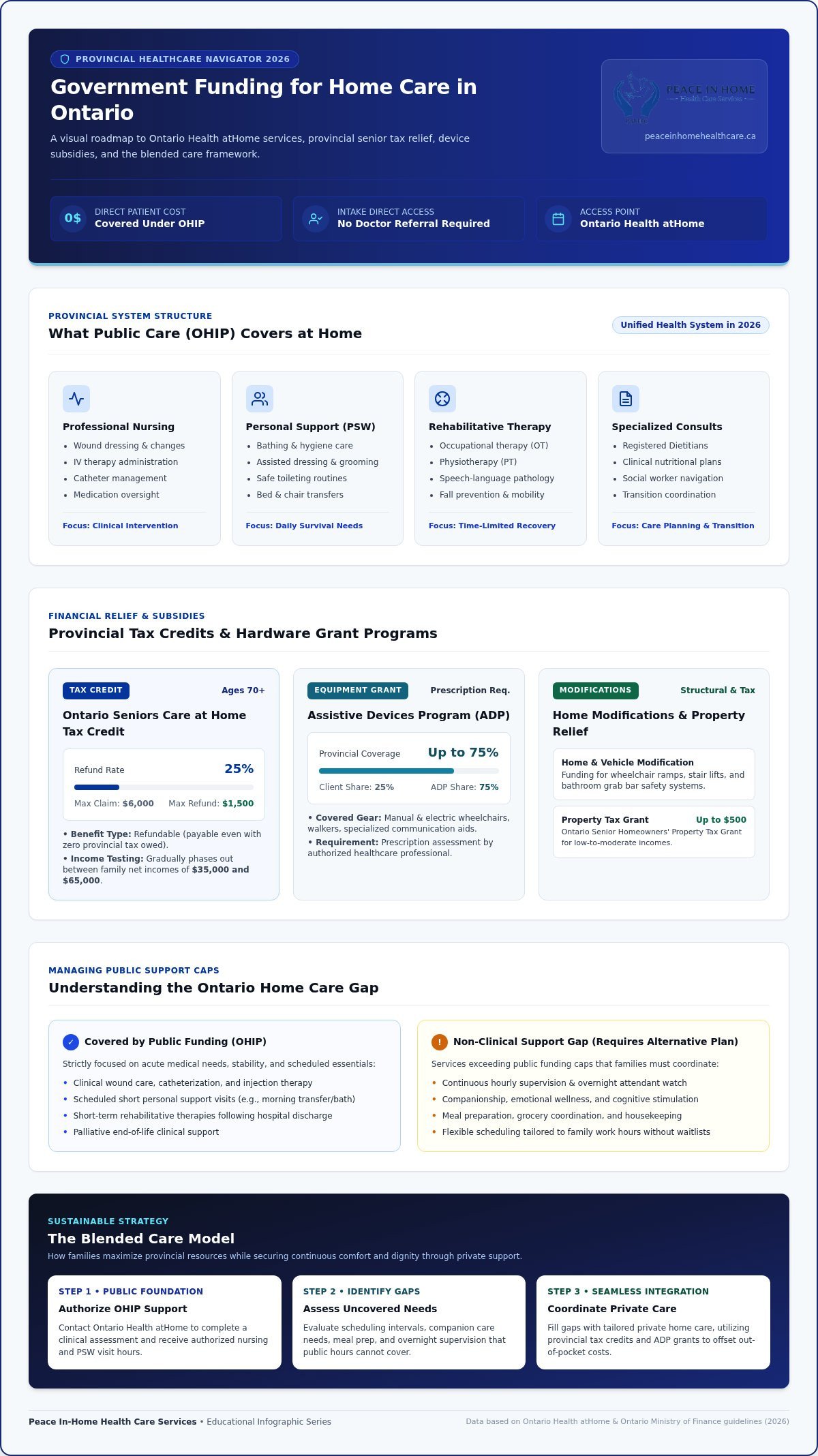
Caring for an aging family member begins with understanding what the province provides. Government funding for home care Ontario 2026 ensures that eligible residents receive essential medical and personal support at no direct out-of-pocket cost through the Ontario Health Insurance Plan (OHIP). Rather than offering unlimited assistance, provincial resources target clinical stability, post-hospital recovery, chronic illness management, and compassionate end-of-life palliative care.
The Role of Ontario Health atHome in 2026
If you have interacted with eldercare in the past, the current system might look unfamiliar. To eliminate bureaucratic fragmentation, the province modernized its structure, moving away from the former Community Care Access Centres (CCACs) and Local Health Integration Networks (LHINs). You can explore the complex history of Ontario’s home care system to understand how these past regional bodies evolved.
In 2026, home and community services operate under a single unified organization: Ontario Health atHome. Working alongside localized Ontario Health Teams, they act as the provincial access gate. When you contact them, a government care coordinator evaluates your family member’s clinical eligibility, drafts an individualized service plan, and authorizes contracted care agencies to deliver support directly in the home.
What Services Does OHIP Cover at Home?
Publicly funded services focus on short-term rehabilitative support and essential daily survival needs. Depending on the coordinator’s assessment, OHIP covers several key clinical categories:
- Professional Nursing Care: Specialized nursing visits for clinical interventions, including wound dressings, IV therapy, catheter management, and medication administration.
- Personal Support: Trained personal support workers (PSWs) assisting with basic daily routines such as bathing, dressing, toileting, and transfers.
- Rehabilitative Therapies: Time-limited occupational therapy, physiotherapy, and speech-language pathology designed to rebuild mobility or prevent dangerous falls.
- Specialized Consultations: Registered dietitians providing clinical nutritional guidance, alongside social workers helping families coordinate complex healthcare transitions.
While government funding for home care Ontario 2026 provides an indispensable clinical foundation, public coverage strictly funds acute medical and physical necessities. Knowing these limits early helps families plan realistic, dignified care routines without sudden surprises.
Provincial Tax Credits and Financial Relief Programs for Seniors
Public support extends beyond visiting nurses and personal support workers. While direct physical visits form the core of government funding for home care Ontario 2026, the province also provides substantial financial relief through targeted tax credits and grant programs. These tools help families offset the out-of-pocket expenses that inevitably arise when maintaining an aging loved one safely at home.
The Ontario Seniors Care at Home Tax Credit
To help families manage necessary medical supplies and attendant care, the province offers the refundable Seniors Care at Home Tax Credit. Ontario seniors aged 70 and older can claim up to 25% on eligible medical expenses up to C$6,000, providing a maximum annual refund of C$1,500. Because it is a refundable tax credit, your loved one can receive these funds even if they owe no provincial personal income tax. The benefit is income-tested, gradually phasing out for family net incomes between C$35,000 and C$65,000.
Assistive Devices Program (ADP) and Accessibility Grants
Creating a secure physical environment often requires specialized aids. The province provides practical assistance through established hardware initiatives:
- Assistive Devices Program (ADP): Covers up to 75% of the approved cost for essential mobility gear, including manual or electric wheelchairs, walkers, and specialized communication devices. Equipment requires a prescription assessment by an authorized healthcare professional.
- Home and Vehicle Modification Program: Delivers provincial funding up to set thresholds for structural home upgrades, such as wheelchair ramps, stair lifts, and bathroom grab bar systems.
- Municipal Property Relief: Initiatives like the Ontario Senior Homeowners’ Property Tax Grant deliver up to C$500 in relief for low-to-moderate-income seniors aged 64 and older.
Federal Medical Expense Tax Credit and Disability Tax Credit
Tax relief multiplies when you combine provincial benefits with federal filings. Families employing supplemental private care can claim attendant services under the Medical Expense Tax Credit (METC) if supported by proper medical certification. The federal Disability Tax Credit (DTC) provides additional non-refundable relief for individuals facing severe, prolonged physical or cognitive impairments, while relatives providing primary daily support can explore the Canada Caregiver Credit.
Families often find that government funding for home care Ontario 2026 pairs effectively with personalized care solutions. To explore how private home care services for seniors in Toronto work alongside tax write-offs, you can reach out to our care team for compassionate, structured guidance.
Applying for Ontario Public Home Care: Step-by-Step
Starting the process to receive public healthcare at home is more straightforward than many realize. Anyone in Ontario can request an evaluation, and you do not need a physician’s referral to get started. Securing government funding for home care Ontario 2026 involves three distinct stages, from your initial phone call to the arrival of care workers at the front door.
Step 1: Initiating Contact and Referral
To begin, contact Ontario Health atHome directly by dialling 310-2222 (no area code required) or toll-free at 1-833-515-1234. If your loved one is currently admitted to a hospital, a hospital care coordinator or social worker will initiate this referral internally before discharge. When placing the call yourself, have essential details organized in advance:
- Your family member’s valid Ontario Health Card (OHIP) number and residential address
- A full list of current medical diagnoses, specialists, and primary care physicians
- An accurate summary of all daily prescription medications and current dosages
Step 2: The In-Home Assessment and RAI-HC Evaluation
Following intake screening, a registered care coordinator conducts an in-person assessment in the home. Coordinators use standardized clinical evaluation tools, primarily the Resident Assessment Instrument for Home Care (RAI-HC). This framework evaluates how independently a senior manages Activities of Daily Living (ADLs), such as personal hygiene, dressing, mobility, and meal preparation.
Family caregivers should always attend this meeting. Seniors often downplay physical struggles out of pride or fear of losing independence. Be completely transparent about physical instability, nighttime wandering, caregiver exhaustion, and cognitive changes. Clear, candid details ensure the coordinator captures the true level of daily vulnerability, which directly dictates service priority.
Step 3: Service Determination and Provider Assignment
Once the evaluation concludes, the coordinator establishes an individualized care plan specifying your approved weekly personal support or nursing visits. Ontario Health atHome does not employ field caregivers directly; instead, they contract approved service agencies to deliver the assigned hours. The timeline for services to begin varies widely based on local agency staffing and urgency tiers.
Families receive the direct contact details for their assigned care coordinator. If health conditions decline or approved visits fall short, this coordinator serves as your primary contact to request an updated assessment under government funding for home care Ontario 2026.
Navigating Public Funding Limits: Addressing the Home Care Gap
While securing government funding for home care Ontario 2026 provides vital medical relief, families quickly discover its practical boundaries. Public allocations serve as a clinical safety net rather than an all-inclusive daily living solution. This reality often leaves significant gaps during evenings, weekends, and non-clinical daily routines.
What Government Funding Does Not Cover
Public resources focus almost exclusively on direct physical and medical care. As a result, Ontario Health atHome cannot authorize hours for domestic lifestyle assistance or emotional support. Provincial funding strictly excludes:
- Nutritious meal preparation, grocery shopping, and prescription pickup
- Routine domestic tasks like laundry, bed linen changes, and light housekeeping
- Continuous companionship to relieve loneliness, depression, or social isolation
- Overnight monitoring and live-in supervision to prevent dangerous wandering or falls
When daily domestic routines become unmanageable, dedicated personal care assistance for seniors helps bridge the gap to maintain safe, dignified living conditions at home.
The Reality of Waitlists and Service Caps Across Ontario
High demand across the province means publicly funded personal support hours are strictly rationed. Non-palliative clients rarely receive more than a few hours of personal support each week. In large urban centres, staffing pressures can also cause delays between the initial assessment and your first scheduled visit.
Public visits often involve rotating agency staff arriving at inconsistent times. A revolving door of unfamiliar faces can cause profound distress for seniors living with cognitive decline or Alzheimer’s disease. Private home care supplements these hours with consistent, dedicated caregivers who arrive at predictable times tailored to your loved one’s natural rhythm.
Protecting Family Well-Being and Preventing Burnout
When public allocations reach their limit, family members routinely absorb the remaining care duties. Juggling career deadlines and child-rearing alongside nighttime bathroom assistance or heavy lifting takes a severe toll. Chronic sleep disruption and emotional strain quickly lead to physical and psychological exhaustion.
Relying exclusively on capped allocations under government funding for home care Ontario 2026 often strains the delicate bond between parent and child. Scheduling supplemental respite care gives family caregivers reliable time to rest, work, and recharge. Review our practical guide to preventing caregiver burnout Toronto to learn how structured relief protects everyone in the home.
Sustainable Blended Care with Peace In-Home Health Care
Navigating eldercare doesn’t mean choosing between strictly limited public visits and exhausting family caregiving. A blended care model brings together the best of both worlds. By pairing government funding for home care Ontario 2026 with private support, families create a complete safety net that protects both their loved one’s independence and their household balance.
Harmonizing Public Care Hours with Private Support
Public support workers provide indispensable assistance, but their time is often constrained to brief morning or evening hygiene visits. Peace In-Home Health Care Services coordinates directly around your approved Ontario Health atHome schedule, stepping in the moment public workers depart. This cooperative approach ensures your parent never experiences long, disorienting intervals without support.
While public visits focus on acute physical care, our caregivers manage daily essentials that foster a comfortable living environment:
- Preparing wholesome, home-cooked meals aligned with dietary guidelines
- Providing dedicated companionship care to ease afternoon anxiety and loneliness
- Managing light housekeeping, laundry, and daily medication reminders
- Assisting with mobility and transfer routines to prevent dangerous household falls
For seniors recovering from surgery or managing advanced illness, our registered staff deliver specialised oversight. Learn how skilled nursing care at home Toronto provides hospital-level clinical treatments right in the comfort of your living room.
Personalized Support Across Toronto, Peel, and York Region
With over 17 years of experience guiding local families through complex health transitions, Peace In-Home Health Care Services understands that every household routine is unique. We provide dedicated personal support and nursing across Toronto, Mississauga, Vaughan, Markham, Oakville, Richmond Hill, and surrounding GTA communities. Rather than fitting your family into rigid agency blocks, our schedules adapt to your life.
Support can range from a few hours of weekly respite care to relieve family exhaustion, to full-time live-in care for seniors requiring overnight reassurance. As physical needs shift or rehabilitation goals are reached, your service adapts naturally. Blending private attention with government funding for home care Ontario 2026 ensures your loved one receives consistent, dignified care while your family regains peace of mind.
Connect with our compassionate team today to build a personalized home care plan tailored to your family’s exact needs.
Securing Dignified, Continuous Care for Your Loved One
Accessing government funding for home care Ontario 2026 provides your family with a vital clinical baseline, but genuine peace of mind comes from looking at the entire care picture. Combining public hours from Ontario Health atHome with refundable provincial tax relief and tailored supplemental support ensures your loved one stays safe without placing an impossible burden on your shoulders.
With over 17 years of trusted senior care experience across the GTA, Peace In-Home Health Care offers compassionate registered nurses and certified personal support workers who integrate smoothly around your public visit schedule. You don’t have to carry the emotional and physical weight of caregiving on your own.
With a dependable circle of care in place, you can step away from managing exhausting daily logistics and return to what matters most: cherishing meaningful moments together.
Frequently Asked Questions
Can my elderly parent receive 24-hour care through government funding in Ontario?
No, government funding for home care Ontario 2026 does not cover around-the-clock or 24-hour in-home supervision for non-palliative cases. Public resources allocate visits in short daily or weekly blocks for essential personal support and nursing tasks. If your loved one is at risk of falling or wandering overnight, families typically bridge this gap by arranging private live-in care or overnight respite care to ensure continuous safety.
How long does it take to get approved for Ontario Health atHome services in 2026?
Assessment timelines depend on medical urgency and regional triage levels. Urgent hospital discharges often receive an initial consultation within 24 to 48 hours, while community referrals placed from home can take several weeks for an in-person assessment. Once approved, actual service start dates vary across regions like Toronto, Mississauga, and York Region based on contracted agency staffing availability and caregiver capacity.
Can we choose our own caregiver through the Ontario government home care system?
Generally, no. Ontario Health atHome assigns contracted service provider agencies based on territorial coverage and internal staffing availability. Families cannot select specific individual personal support workers or nurses under standard public allocations, which often leads to rotating staff. However, under direct funding self-directed care models, eligible families receive a predetermined budget to recruit, hire, and schedule their own preferred caregivers directly.
What happens if our allocated government home care hours are not enough?
You can contact your assigned Ontario Health atHome care coordinator to request a formal reassessment if your loved one’s health declines. When public limits are reached, families frequently turn to a blended care approach. Supplementing capped public hours with private personal support, meal preparation, or companionship care ensures your parent remains safe and supported without placing unbearable physical strain on family caregivers.
Is the Ontario Seniors Care at Home Tax Credit based on family income?
Yes, this refundable provincial credit is income-tested. Eligible seniors aged 70 and older receive up to 25% back on claimable medical expenses up to C$6,000, delivering a maximum annual refund of C$1,500. The full benefit applies to net family incomes up to C$35,000 and phases out gradually, becoming unavailable once net family income exceeds C$65,000 on your annual provincial tax return.
Can we use private home care services while receiving publicly funded visits?
Yes, you can combine private care with government funding for home care Ontario 2026 without losing your public benefits. Private caregivers work cooperatively around your authorized Ontario Health atHome schedule. For instance, a private agency can arrive in the afternoon to provide meal preparation, companionship, and medication reminders after a public personal support worker completes morning hygiene assistance.
Does OHIP cover home physiotherapy, occupational therapy, and nursing visits?
Yes, OHIP covers professional in-home clinical visits when authorized through an official Ontario Health atHome care plan. This includes specialized nursing for wound management or catheter care, as well as short-term occupational therapy and physiotherapy aimed at restoring functional mobility after surgery or illness. Once rehabilitative goals are achieved or progress plateaus, these therapies are discharged from public coverage.