

What if the most loving choice you can make for your aging parent isn’t to work harder as their full-time nurse, but to step back and simply be their daughter or son again? Many families across the GTA feel the heavy weight of caregiver burnout, often triggered by sleepless nights spent listening for a fall or the quiet click of a door that might signal wandering. If you’re feeling overwhelmed, you aren’t alone in searching for a reliable way to provide 24 hour home care for elderly Toronto residents while preserving their dignity and your own mental health.
It’s completely natural to feel torn between your desire to keep a loved one at home and the reality of their complex medical or safety needs. You deserve a solution that replaces constant anxiety with professional reassurance. This comprehensive guide explains how around-the-clock support creates a secure environment for your parent and finally allows you to breathe. We’ll help you understand how to move from a state of crisis to a stable, compassionate care plan that works for everyone involved.
We will break down the differences between government-funded support through Ontario Health atHome and private options, including the mandatory 2026 licensing standards that protect your family. You’ll also learn how personalized care models, from live-in support to rotating shifts, can be tailored to your specific neighbourhood and lifestyle. By the end of this guide, you’ll have a clear path toward restoring peace in your home.
Key Takeaways
- Learn to identify the physical and cognitive signals, such as sundowning, that indicate your loved one requires the safety of around-the-clock supervision.
- Compare the practical differences between live-in care and shift-based models to find a reliable solution that fits your family’s specific needs and budget.
- Discover how specialized 24 hour home care for elderly Toronto provides a secure environment through professional medication management and mobility support.
- Understand the essential criteria for vetting GTA agencies, including verifying specialized dementia training and the latest 2026 provincial licensing requirements.
- Explore how a personalized care plan allows you to transition from being a full-time caregiver back to a supportive daughter or son.
Recognizing the Need for 24-Hour Home Care for Elderly in Toronto
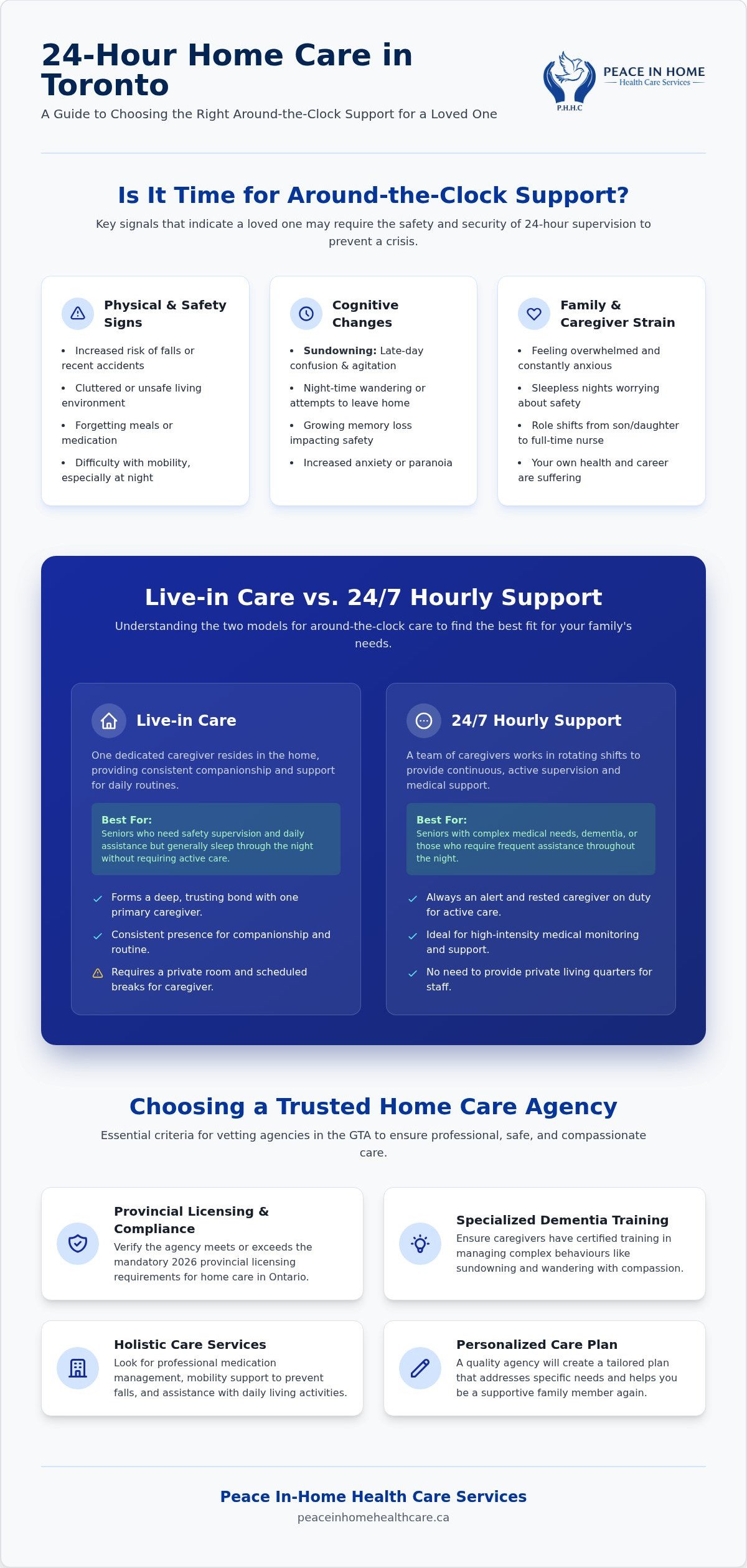
Deciding when to transition to around-the-clock support is rarely a single moment. It’s usually a series of small, worrying events that eventually lead to a tipping point. You might notice your parent is forgetting to eat, or perhaps their home, once tidy, is becoming cluttered and unsafe. These physical signs often signal that a higher level of supervision is required to maintain their health. When exploring What is Home Care?, it’s helpful to view it as a comprehensive safety net that catches the risks occurring when no one is looking.
Cognitive changes often present the most urgent need for 24 hour home care for elderly Toronto residents. Many seniors with dementia experience “sundowning,” a state of increased confusion and anxiety that begins in the late afternoon. This can lead to pacing, agitation, or even attempts to leave the house during the night. Without professional support, these evening hours become a source of intense stress for family members who cannot stay awake indefinitely to ensure their loved one’s safety.
In Ontario, where over 723,000 seniors are living with frailty, the risks of living alone can escalate quickly. Unmanaged medication errors or a simple trip in a dark hallway can lead to life-altering injuries. Validating the emotional toll on you is just as important as addressing your parent’s physical needs. Trying to provide 24/7 support on your own isn’t just exhausting; it’s a recipe for a family crisis that impacts your own health and career.
Safety First: Preventing Falls and Emergencies
A 24-hour presence significantly reduces the risk of hip fractures and hospitalizations by providing immediate mobility assistance during those critical midnight hours. If your parent wakes up confused at 3:00 a.m. and tries to walk to the bathroom alone, a caregiver is there to offer a steady hand. This immediate response prevents the wandering that often leads to emergencies. For those noticing early indicators of decline, reviewing 5 Signs Your Elderly Parent Needs Personal Care at Home can help you decide if it’s time to step up the level of support.
The Caregiver’s Peace of Mind
Caregiver burnout is a serious condition that can lead to physical illness and emotional withdrawal, eventually damaging the very relationship you’re trying to protect. By bringing in professional support, you shift the focus from being a task-oriented nurse back to being a supportive daughter or son. You can enjoy a cup of tea and a conversation without worrying about the laundry or the next medication dose. Respite care is a necessary tool for maintaining the health of the entire family unit, not a luxury to be used only in a crisis.
Live-in Care vs. 24/7 Hourly Support: Which is Right for You?
Choosing the right structure for 24 hour home care for elderly Toronto is a decision that balances your parent’s safety with your family’s budget and logistical reality. There are two primary ways to provide around-the-clock support. One involves a single caregiver living in the home; the other uses a team of professionals working in rotating shifts. Both models aim to preserve dignity, but they serve very different clinical and personal needs.
The choice often depends on the “intensity” of care needed during the night. If a senior sleeps through the night but needs the security of a nearby presence, one model is ideal. If they require active medical monitoring or help every two hours, a different approach is necessary. Understanding these differences helps you avoid paying for more care than is required or, conversely, leaving a caregiver unsupported in a high-needs environment.
The Logistics of Live-in Care
This model is often the preferred choice for seniors who need consistent companionship and help with daily routines but don’t require constant medical intervention throughout the night. For this to work, the caregiver needs a private, furnished room and scheduled daily breaks. This stability allows for a deep, trusting bond to form between the senior and their provider. It’s a cornerstone of successful aging in place Toronto strategies. When setting up this arrangement, referring to the Government of Canada’s guide on Home Safety for Seniors ensures the environment is optimized for long-term success. While live-in care is generally more cost-effective, it requires the senior to be able to sleep through most of the night.
24/7 Hourly Care for Complex Needs
If your loved one has high medical needs or experiences frequent nighttime agitation, hourly care is the safer path. In this model, caregivers work in 8 or 12 hour shifts, ensuring a fresh, alert professional is always awake and attentive. This is particularly critical for those requiring palliative care or managing advanced dementia where wandering is a risk. Often, these rotations include skilled nursing care at home Toronto to manage complex wound care or specialized injections. Because there is always someone awake, there’s no need to provide a bedroom for the staff. If you’re still unsure which model fits your family’s unique situation, you can speak with a care coordinator to explore your options.
Specialized 24-Hour Support for Dementia and Complex Health
Caring for a senior with Alzheimer’s or other forms of dementia requires a level of patience and specialized skill that goes far beyond basic supervision. With an estimated 334,500 older adults in Ontario currently living with dementia, the need for tailored support has never been more urgent. Providing 24 hour home care for elderly Toronto residents means creating a rhythm that respects their history while managing the unpredictable nature of cognitive decline. By keeping your loved one in their own familiar neighbourhood and home, you help reduce the “transfer trauma” often associated with moving to a long-term care facility.
A comprehensive care plan integrates clinical needs with daily comfort. This includes precise medication reminders to prevent dangerous errors and mobility assistance to ensure every trip to the kitchen or bathroom is safe. Nutritional support is equally vital; caregivers prepare fresh, healthy meals that cater to specific dietary requirements, ensuring your parent stays hydrated and well-nourished. These routines provide the structure and predictability that seniors with complex health needs depend on to feel secure.
Managing Dementia and Wandering
Wandering is one of the most frightening challenges for families, especially during the quiet hours of the night. Professional caregivers use gentle redirection techniques to manage nighttime anxiety, meeting the senior in their reality rather than arguing with them. You can secure the home by using simple strategies like installing door chimes or placing familiar items in clear view to reduce confusion. To keep your loved one’s mind active and calm during the day, it’s helpful to explore engaging activities for dementia patients at home. These meaningful interactions help reduce the agitation that often leads to difficult evenings.
Skilled Nursing and Post-Hospital Recovery
The transition from a hospital bed back to a home environment is a vulnerable time. Whether your parent is being discharged from Sunnybrook, University Health Network (UHN), or another Toronto hospital, a 24-hour care team provides the bridge they need for a successful recovery. This model coordinates the daily support of Personal Support Workers (PSWs) with the clinical oversight of registered nurses. Around-the-clock monitoring includes vital sign checks, complex wound care, and catheter management. Having a professional present 24/7 ensures that any subtle change in health is noticed immediately, significantly reducing the likelihood of a stressful hospital readmission.
Navigating Home Care in the GTA: Choosing the Right Agency
Selecting the right partner for 24 hour home care for elderly Toronto is one of the most significant decisions your family will make. It’s about more than just finding someone to help with daily tasks; it’s about inviting a professional into your parent’s most personal space. To ensure their safety and your own peace of mind, you must look for an agency that prioritizes accountability. This starts with verifying that the provider holds a valid Temporary Help Agency (THA) License, which became a mandatory requirement for all Ontario home care agencies in May 2026.
You’ll also need to decide between a caregiver registry and a full-service agency. A registry often acts as a matching service, leaving you as the legal employer responsible for payroll taxes, WSIB, and liability insurance. In contrast, a full-service agency employs the caregivers directly, handles all administrative burdens, and provides the essential layer of insurance that protects your family. A reliable agency also begins every relationship with a personalized care assessment in the senior’s own home, ensuring the care plan is tailored to their specific environment and personality.
Local Standards and Accountability
In the GTA, local supervision is what separates a generic service from a high-quality care partner. You should look for an agency that conducts regular care plan reviews to adjust for any changes in your parent’s health. Because 24/7 support is a continuous commitment, backup protocols are vital. Ask potential providers how they handle unexpected absences. If a caregiver is delayed by a TTC disruption or heavy traffic on the 401, the agency should have a clear, immediate plan to ensure your loved one is never left unattended.
Questions to Ask During a Consultation
When you meet with a care coordinator, come prepared with specific questions that address the reality of around-the-clock supervision. Focus on their overnight protocols and how they maintain a high standard of care during the quietest hours. You might ask:
- What specific emergency procedures do you have in place for medical crises that occur overnight?
- How do you ensure caregivers remain alert and attentive during 12-hour night shifts?
- What is your process for matching a caregiver’s personality and language skills with my parent’s preferences?
Finding Peace of Mind with Peace In-Home Health Care Services
At Peace In-Home Health Care Services, we believe that our name should represent the ultimate outcome for every family we serve. We understand the anxiety of searching for a reliable partner in a crowded market, especially when the safety of a parent is at stake. For over 17 years, we’ve stood alongside families as a trusted guide, providing 24 hour home care for elderly Toronto residents with a focus on preserving dignity and independence. We don’t just see a set of clinical tasks; we see a person with a rich history who deserves to age in their own neighbourhood with respect and comfort. Our “human-first” approach ensures that every interaction is rooted in empathy, reliability, and professional excellence.
Our philosophy is built on the idea that quality care should be a stable, comforting presence during a time of uncertainty. We take pride in being a seasoned professional presence that has seen it all but has never lost the capacity for kindness. By choosing to work with us, you aren’t just hiring a service; you’re gaining a partner that advocates for your parent’s well-being and navigates the complexities of the Ontario health system alongside you. We’re committed to providing a steady hand that allows your family to move forward without the weight of constant worry.
Our Tailored Approach to 24-Hour Care
We recognize that no two families in the GTA are exactly alike, which is why we move away from a “one-size-fits-all” model. Instead, we create a personalized care plan that evolves as your loved one’s needs change over time. Whether your parent requires intensive medical support or simply the security of a consistent presence, our team is equipped to handle the transition with grace. A core part of our 24/7 strategy involves companionship care for seniors Toronto, ensuring that emotional well-being is prioritized alongside physical safety. We proudly serve communities across the GTA, including Vaughan, Markham, and Mississauga, bringing professional support directly to your doorstep.
Taking the Next Step Together
Making the decision to transition to professional 24 hour home care for elderly Toronto is an act of profound love. It’s the moment you choose to prioritize your parent’s safety while reclaiming your own role as a family member. Our goal is to restore the harmony in your household, replacing the exhaustion of caregiving with the peace of knowing your parent is in expert hands. We’re here to provide the security and comfort your loved one deserves, while offering you the freedom to focus on quality time together. Let us help you navigate this transition with a clear, low-stress path forward.
Restoring Safety and Peace to Your Family Home
Deciding to move your parent to around-the-clock support is a courageous step toward ensuring their safety and your own health. You’ve learned how to recognize the signals of decline, from nighttime agitation to fall risks, and how to navigate the logistical differences between live-in and hourly care. By choosing a partner with 17+ years of experience in specialized dementia and Alzheimer’s support, you’re securing a future where your loved one can age in place with the safety they deserve.
Finding the right 24 hour home care for elderly Toronto means moving beyond clinical checklists to find a team that truly values your family’s unique needs. Professional support across Toronto, Vaughan, and Markham is available to lift the weight of caregiver burnout from your shoulders. It’s time to return to your role as a supportive daughter or son while we provide the steady, reliable hand your parent needs.
You don’t have to navigate this transition alone. We’re here to help you find the peace of mind you’ve been searching for.
Frequently Asked Questions
Is 24-hour home care more expensive than a nursing home in Toronto?
Private home care is generally more expensive than a government-subsidized long-term care bed because it offers dedicated, one-on-one attention. While nursing home costs are capped by provincial regulations, waitlists in Toronto are often years long. Choosing home care allows your parent to stay in their familiar environment immediately. This investment prioritizes their comfort and dignity while avoiding the stress of a clinical facility transition.
Can I get government funding for 24-hour home care in Ontario?
Public funding for 24 hour home care for elderly Toronto is limited through Ontario Health atHome. Most eligible seniors receive only a few hours of support per week based on a medical assessment. Because these government hours are rarely enough for around-the-clock needs, many families supplement them with private care. This ensures their parent is never left alone, especially if they are at risk for falls or wandering.
What is the difference between live-in care and 24/7 hourly care?
Live-in care involves one caregiver who resides in the home and requires a private room, while 24/7 hourly care uses a team working in shifts. Hourly care is the best choice for seniors who are awake frequently or need active medical monitoring. Live-in care is a more cost-effective model for those who sleep through the night but need the security of a nearby, reliable presence for emergencies.
How do you ensure the safety of my parent during the night?
We ensure safety through constant monitoring and specialized redirection techniques for seniors with cognitive decline. Caregivers are trained to manage sundowning episodes and provide immediate mobility assistance for midnight bathroom trips. Having an alert professional present prevents the confusion that leads to falls or wandering. This watchful eye provides the security needed to prevent hospitalizations and ensures your loved one remains safe in their own bed.
Do 24-hour caregivers provide medical nursing or just personal care?
Our teams can include both Personal Support Workers (PSWs) for daily living tasks and Registered Nurses for skilled medical needs. While personal care covers bathing, dressing, and meal prep, our skilled nursing services handle complex tasks like wound care and medication administration. We tailor the staff mix to your parent’s health requirements, ensuring they receive the appropriate level of clinical oversight and dignified support at all times.
What happens if our regular 24-hour caregiver is sick or unavailable?
We maintain a robust backup protocol to ensure your parent is never left without professional support. As a full-service agency, we manage a team of qualified professionals and will send a replacement caregiver if your regular provider is unavailable. You don’t have to worry about scheduling or finding a last-minute substitute. We handle all the logistics to maintain the continuity and reliability of your personalized care plan.
How quickly can 24-hour home care be started in an emergency?
We can often begin 24 hour home care for elderly Toronto within 24 to 48 hours of your initial assessment. In urgent situations, such as a sudden hospital discharge or a primary caregiver’s health crisis, we work quickly to coordinate a reliable care team. Our goal is to alleviate your stress immediately by providing a steady, professional presence during a time of high pressure and family uncertainty.
Can 24-hour care be provided in a retirement home or hospital setting?
Yes, our caregivers can provide supplemental support in hospitals, retirement homes, or long-term care facilities. This bedside care ensures your parent receives personalized, one-on-one attention that institutional staff may not be able to provide. Whether they are recovering from surgery at a Toronto hospital or need extra help in a retirement residence, we provide the consistent companionship and advocacy needed to improve their daily comfort and safety.