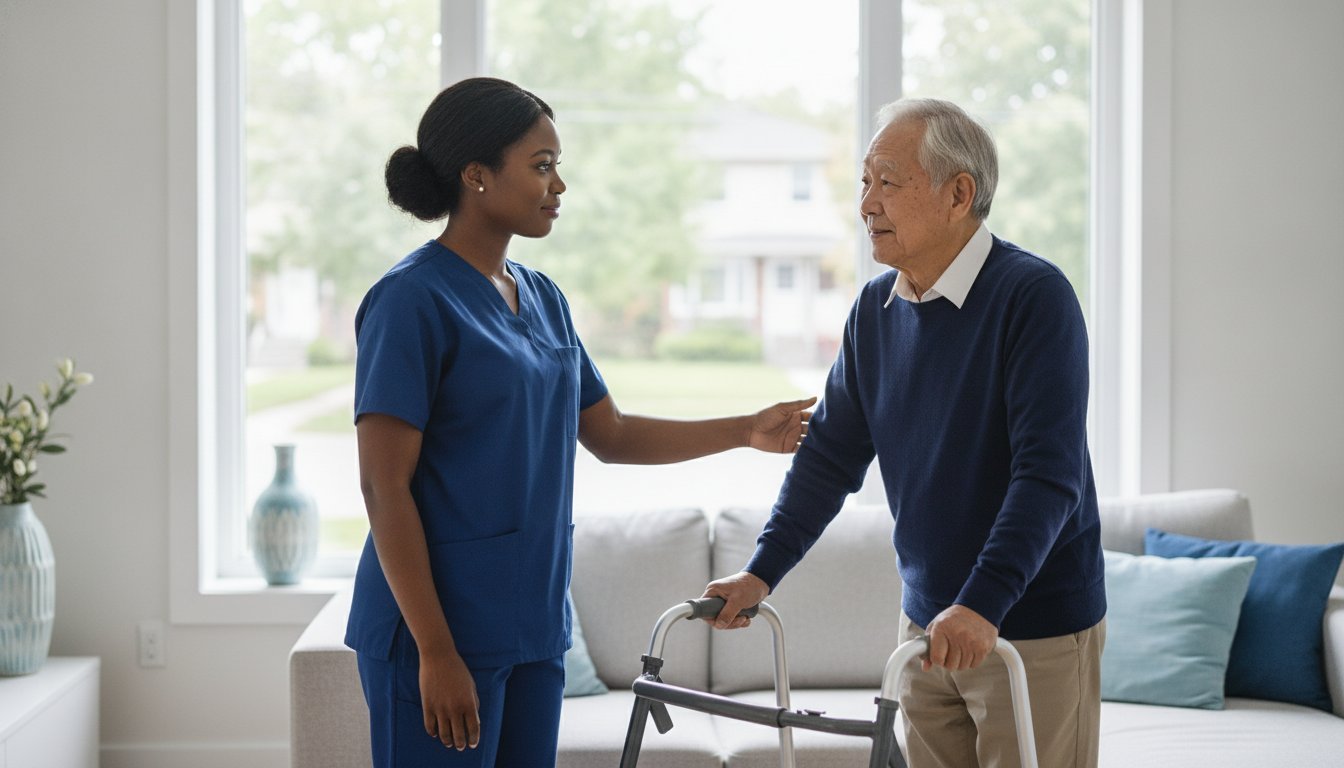
What if the expensive walker you just purchased is only doing half the job of keeping your loved one safe? Many families believe that equipment alone is the answer, but without the right support, even the best tools can become trip hazards. You likely feel the constant weight of worry about a hip fracture or the physical strain of helping your parent stand up from their favourite chair. It’s a heavy burden to carry alone, and it’s natural to feel overwhelmed by the choice between buying more gadgets or seeking professional help.
We understand that maintaining independence is about more than just moving from room to room; it’s about feeling secure and respected in your own home. Discover how professional mobility assistance for seniors Toronto can prevent falls, protect your own physical health from caregiver burnout, and help your loved one move with renewed confidence. This article provides a clear safety checklist to organize your home, explains when professional transfer assistance becomes essential, and offers a practical plan to ensure your family enjoys lasting peace of mind.
Key Takeaways
- Learn how to identify the “subtle slide” of mobility loss before a fall occurs, ensuring you can intervene with care and confidence.
- Access a comprehensive 5-point safety checklist designed to secure high-risk areas like bathrooms and stairs in your loved one’s home.
- Understand why professional mobility assistance for seniors Toronto provides a vital layer of safety that equipment like walkers cannot offer on their own.
- Discover how to navigate the unique architectural challenges of Toronto homes and connect with local GTA resources for tailored support.
- Realize how a personalized mobility plan preserves dignity and restores the joy of moving safely through a familiar environment.
Evaluating Mobility Challenges for Seniors in Toronto
Mobility assistance is often misunderstood as simply providing a walker or a cane. In reality, true support is a thoughtful combination of physical aid, environmental adaptations, and consistent gait monitoring. It’s about looking at the whole person and their home environment to ensure they can move with confidence. For many families, the need for mobility assistance for seniors Toronto becomes most apparent during our harsh winters. When sidewalks in North York or downtown Toronto become slick with ice, a slight imbalance that was manageable in the summer can quickly turn into a life-altering risk. This makes professional support a year-round priority rather than a seasonal luxury.
We often see what we call the “subtle slide.” This is the gradual, almost invisible decline in a senior’s ability to move safely. It doesn’t always start with a dramatic fall. Instead, it begins with small changes in how a person navigates their living room or kitchen. Beyond the physical risks, losing the ability to move freely has a profound psychological impact. When a senior no longer feels safe walking to the local park or visiting a neighbour, they often retreat into their home. This withdrawal can lead to deep social isolation, which is a significant health risk for the growing population of seniors in the GTA.
The Red Flags of Mobility Decline
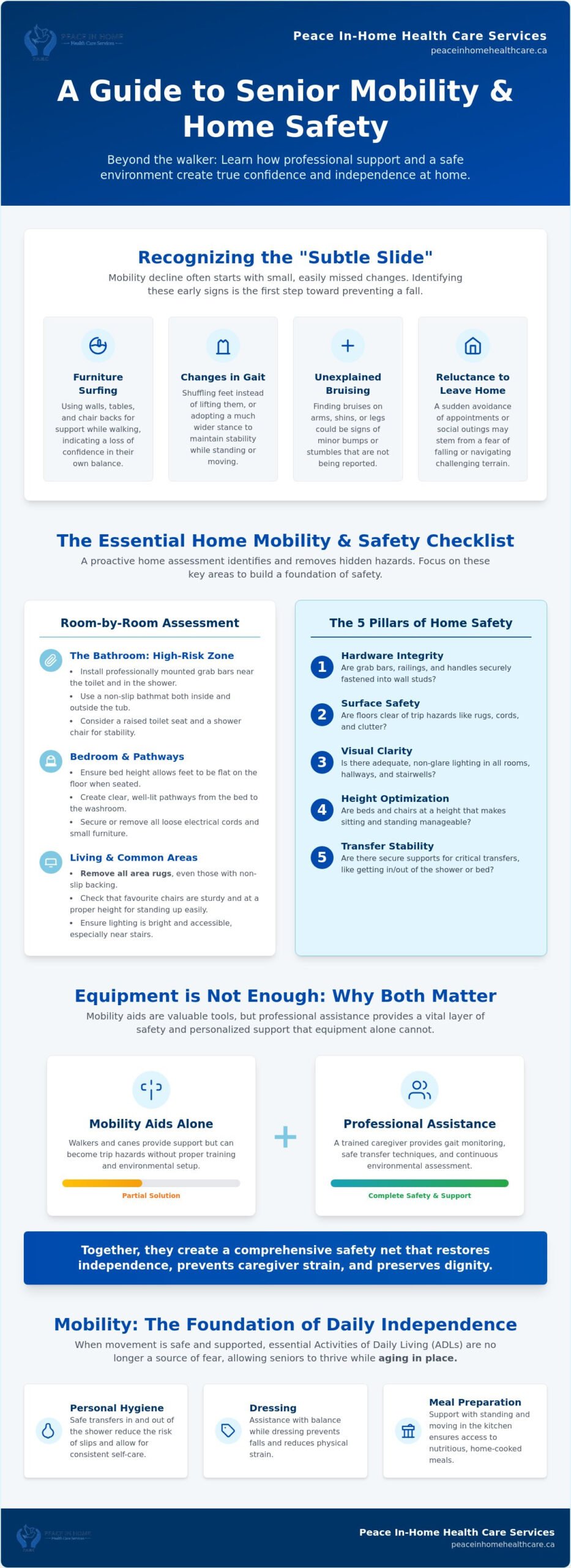
One of the most common signs of a “subtle slide” is something professionals call furniture surfing. You might notice your loved one touching the backs of chairs, leaning on the kitchen counter, or gripping the doorway as they move through the house. They are using their environment as a makeshift mobility aid because they no longer trust their own balance. Other red flags include a change in gait, such as shuffling their feet instead of lifting them, or adopting a wider stance to stay upright. If you notice unexplained bruising on their arms or legs, or if they seem suddenly reluctant to leave the house for appointments, it’s time to realize that their mobility needs have changed.
The Role of Activities of Daily Living (ADLs)
Mobility is the foundation for almost every daily task, from bathing and dressing to preparing a simple meal. When movement becomes difficult, these essential activities of daily living (ADLs) often suffer. A senior who is afraid of slipping in the shower may begin to avoid personal hygiene, or someone who finds it painful to stand at the stove might stop eating nutritious meals. Supporting these movements is critical for anyone wishing to pursue Aging in place, as it allows them to remain in the comfort of their own home while staying safe. Activities of Daily Living are the basic tasks of self-care that, when supported by mobility assistance for seniors Toronto, allow an individual to maintain their independence and dignity.
The Essential Home Mobility & Safety Checklist
Creating a safe environment for an aging parent involves more than just buying a new walker. It requires a systematic look at how they interact with their surroundings every day. While equipment is helpful, the most effective mobility assistance for seniors Toronto families can implement is a proactive assessment of the home itself. This process helps identify hidden hazards before they lead to a trip to the emergency room. Following the Government of Canada fall prevention guidelines, we recommend a consistent review of these five key areas: hardware integrity, surface safety, visual clarity, height optimization, and transfer stability. By focusing on these pillars, you can build a foundation of safety that adapts as your loved one’s needs change.
Room-by-Room Mobility Assessment
Start in the bathroom, which is statistically the most dangerous room in the house. Ensure grab bars are professionally installed into wall studs rather than using suction cups; these should be placed both near the toilet and inside the shower. In the bedroom, check that the bed height allows your loved one to sit with their feet flat on the floor before standing. Clear pathways are essential, so move any cords or small pieces of furniture that block the route to the washroom. In the living area, the most important task is removing area rugs. Even with non-slip backing, these represent a significant trip hazard for those who shuffle or use a walker. If your loved one has limited strength, professional Mobility & Transfer Assistance ensures these daily movements don’t become a source of fear or injury.
The Caregiver Support Audit
It’s equally important to check in on the person providing the help. If you find yourself experiencing back pain or physical strain after helping your parent stand, the current routine isn’t sustainable. Safe transfers require specific body mechanics that protect both the senior and the caregiver. When a senior can no longer support their own weight during a transition, tools like gait belts or mechanical lifts become a necessity rather than an option. Professional caregivers are trained to use these tools to maintain the senior’s dignity while preventing the physical burnout that often forces families into difficult long-term care decisions. If you’re feeling the physical toll of caregiving, it may be time to speak with a professional about a personalized safety plan.
Professional Transfer Assistance vs. Mobility Aids: Why Both Matter
Many families begin their journey by accessing Ontario’s Assistive Devices Program (ADP) to secure walkers, wheelchairs, or specialized lifts. While these tools are indispensable, they’re only one part of a truly safe mobility plan. Hardware provides the mechanical means to move, but it lacks the critical judgment and physical steadiness that a trained professional offers. Professional mobility assistance for seniors Toronto bridges this gap, ensuring that the equipment meant to help doesn’t accidentally lead to a new injury. Without a steady hand to guide the process, even the most advanced lift can feel daunting or unsafe for a senior to use alone.
A stairlift or a walker is a static object. It can’t sense when a senior is feeling particularly frail on a Tuesday morning or if they’re experiencing a side effect from a new medication that causes sudden dizziness. This is where personal care assistance for seniors becomes vital. A caregiver doesn’t just watch; they anticipate. They ensure the walker is positioned correctly before the senior stands and that the brakes are firmly engaged. This human oversight transforms a piece of metal into a reliable path toward safety, preventing the “unsupervised mobility” that often leads to accidents when a senior tries to do too much on their own.
It’s common to feel that hiring help means losing independence. We see it differently. Independence is the ability to live in your own home, follow your own schedule, and maintain your dignity. If a fear of falling keeps your loved one confined to one room, they’ve already lost their independence. Professional support restores it by providing the confidence to move through the house again. It’s a supportive partnership that allows your loved one to stay in the home they love for as long as possible.
When Equipment Isn’t Enough
For those living with cognitive decline or dementia, a walker can actually become a hazard if they forget how to engage the brakes or lean on it incorrectly. Stand-by assistance is crucial in these scenarios. A caregiver provides the “human touch” by offering a steadying hand and gentle verbal cues that a machine simply cannot replicate. This attentive care is especially important for seniors prone to vertigo, as it provides an immediate anchor during moments of instability.
Preventing Caregiver Injury
Helping a loved one move isn’t just hard on them; it’s physically taxing for you. Many family members suffer from chronic back pain or joint strain because they haven’t been taught proper transfer mechanics. The Pivot Transfer technique, for example, is a specific way to move someone from a bed to a chair by rotating on one foot, but it requires precise training to perform without straining your own spine. Professional mobility assistance for seniors Toronto protects the health of the entire family, allowing you to focus on being a supportive daughter or son rather than a physically exhausted lifter.
Navigating Mobility Support Services in the Greater Toronto Area
Toronto is a city of diverse neighbourhoods, each with its own architectural character and unique mobility challenges. Whether your loved one is aging in a classic two-storey home in Etobicoke or a modern high-rise in the Downtown core, the physical layout of their environment dictates the level of support they need. Local expertise is essential here. A caregiver who understands the steep, narrow staircases common in older Scarborough homes will approach safety differently than one navigating the long hallways and elevator wait times of a North York condo. Professional mobility assistance for seniors Toronto accounts for these nuances, ensuring that the plan fits the home as well as the individual.
For families in suburban areas like Vaughan and Oakville, the challenges often involve larger property footprints and the need for reliable transportation to appointments. Accessing home care services for seniors Toronto provides a bridge between these geographical hurdles and the desire to stay at home. Families in Markham and the surrounding communities can also find tailored support through home care Markham services that address the specific needs of seniors aging in place in that area. When you begin vetting local agencies, look beyond the list of services. Ask about their specific mobility training standards and how they prepare staff for the GTA’s unpredictable winter conditions. A high-quality provider will have clear, documented protocols for safe transfers and fall prevention that are reviewed regularly.
Toronto Housing and Mobility Obstacles
- Older Homes: In areas like Etobicoke or Scarborough, many houses feature steep stairs and narrow doorways that are difficult to navigate with a standard walker.
- Condo Living: Residents in North York or Downtown often face long walks from the elevator to their front door, which can be exhausting without stand-by assistance.
- Winter Safety: Our icy winters require a specialized approach to mobility, focusing on safe entries and exits from the home during the months of heavy snow and salt.
The Importance of Consistency in Care
Effective mobility support relies on the relationship between the senior and their caregiver. When the same professional visits regularly, they become a “Trusted Guide” who can spot the tiny changes in gait or balance that might indicate a new health concern. This consistency is the best defence against the “subtle slide” mentioned earlier. Beyond physical help, companionship care for seniors Toronto encourages safe movement through light exercise and daily walks, which are vital for maintaining muscle strength and joint flexibility.
At Peace In-Home Health Care Services, we prioritize this continuity. Every member of our team is thoroughly trained in safe transfer protocols, ensuring that your loved one is always in capable hands. If you are ready to create a safer environment for your parent, contact our compassionate team today for a personalized consultation.
How Peace In-Home Health Care Services Restores Independence
We believe that aging at home should be a period of comfort and security, not a time defined by fear. As a Compassionate Expert in the field, Peace In-Home Health Care Services understands that every senior has a unique story and a specific set of physical needs. Our goal is to serve as your Trusted Guide, helping you navigate the transition from independent movement to supported mobility with grace and reliability. By providing professional mobility assistance for seniors Toronto, we ensure that your loved one remains the master of their own environment while receiving the steady hand they need to stay safe. Dignity is at the centre of every physical interaction we facilitate, ensuring your parent feels respected and empowered throughout the day.
Our Approach to Mobility and Transfer Assistance
We don’t believe in one-size-fits-all solutions. Instead, we develop customized care plans that evolve alongside the senior. If a client’s strength improves or their balance changes, our approach shifts to match their current reality. Our staff undergoes rigorous training focused on fall prevention and safe lifting techniques, ensuring that every interaction is both physically secure and emotionally supportive. We also integrate mobility support with other essential services, such as meal preparation and medication reminders. This holistic approach means that your loved one isn’t just moving safely; they’re thriving in a well-managed, attentive household where all their needs are met with patience and care.
Peace of Mind for Toronto Families
The decision to bring a professional into the home is often accompanied by a profound sense of relief. Families frequently tell us that the greatest benefit isn’t just the physical help; it’s the emotional weight that lifts when they no longer have to worry about the physical strain of lifting or the constant threat of a fall. We have seen clients who were previously confined to a single room regain the confidence to join the family at the kitchen table or enjoy the fresh air on their porch. These small victories represent a significant restoration of quality of life. Knowing that a reliable partner is standing by allows you to return to your role as a supportive family member rather than a constant safety monitor.
Taking the first step toward a safer home is simple. We offer a comprehensive in-home assessment for families across the GTA to help identify specific risks and create a tailored plan for your loved one. Book your free mobility assessment today and discover how professional mobility assistance for seniors Toronto can bring peace and stability back to your family life.
Restoring Peace and Confidence in Every Step
Ensuring your parent stays safe at home requires a thoughtful balance of the right tools and the right hands. You’ve learned that while walkers and grab bars are essential, they’re most effective when paired with professional oversight that adapts to changing needs. By addressing the unique architectural hurdles of our city and staying ahead of seasonal risks, you can prevent life-altering falls before they happen.
Peace In-Home Health Care Services brings more than 17 years of experience to families across Toronto, Vaughan, Markham, and the entire GTA. Our caregivers are specially trained in safe transfer and fall prevention, providing the reliable support that protects your loved one’s dignity and your own physical health. Professional mobility assistance for seniors Toronto is about more than just movement; it’s about reclaiming the joy of living independently in a familiar space. Realizing your family needs support isn’t a sign of giving up; it’s a proactive step toward safety.
Ensure your loved one’s safety: Request a Free In-Home Mobility Assessment
You don’t have to carry this burden alone. We’re here to stand alongside your family as a trusted partner, offering the steady hand and expert guidance your loved one deserves.
Frequently Asked Questions
What is the difference between mobility assistance and physical therapy?
Physical therapy is a medical service focused on rehabilitative exercises to restore strength, balance, or range of motion after an illness or surgery. Mobility assistance provides the daily, hands-on support needed to navigate the home safely, such as help standing from a chair or walking to the washroom. While a therapist sets goals for recovery, a mobility caregiver ensures that every movement throughout the day is performed with dignity and safety.
How much does mobility assistance for seniors in Toronto typically cost?
The cost of mobility assistance for seniors Toronto depends on the frequency of visits and the specific level of care your loved one requires. Since every family’s situation is unique, we provide personalized quotes after an in-home assessment to ensure the plan fits your budget and needs. Factors such as the length of each visit and whether specialized transfer training is needed will influence the final rate for services.
Does my insurance cover in-home mobility support in Ontario?
Standard OHIP coverage generally doesn’t include private in-home mobility support, although some government-funded programs may offer limited hours through local health authorities. Many families use private health insurance, Veterans Affairs benefits, or long-term care insurance policies to help manage the costs. It’s helpful to remember that while Ontario’s Assistive Devices Program (ADP) covers equipment, it doesn’t provide funding for the professional care needed to use that equipment safely.
Can a caregiver help my parent use a mechanical lift or Hoyer lift?
Our caregivers are specifically trained to assist with mechanical transfers, including the use of Hoyer lifts or sit-to-stand devices. We prioritize safety for both the senior and the caregiver, ensuring these tools are used with the correct technique to prevent injury or discomfort. Having a professional manage these complex transfers provides immense relief for family members who may find the equipment intimidating or physically demanding to operate alone.
What should I do if my parent refuses to use their walker or cane?
Resistance to using a mobility aid often stems from a fear of losing independence or a feeling that the device makes them look frail. We recommend shifting the conversation to focus on how the walker actually increases their freedom by allowing them to move without pain or fear. Sometimes, hearing this from a neutral third party, like a professional caregiver, is more effective than hearing it from a family member, as it removes the emotional tension.
How do I know if my parent needs a wheelchair or just a walker?
Choosing between a walker and a wheelchair usually depends on your loved one’s ability to bear weight and their overall endurance. If they can walk short distances but feel unsteady, a walker might be the right fit for maintaining muscle strength. However, if they experience significant pain or exhaustion after just a few steps, a wheelchair offers a safer way to remain active. An Occupational Therapist can provide a formal assessment to help you make the best choice.
Does Peace In-Home Health Care provide services in Mississauga and Brampton?
Peace In-Home Health Care proudly serves families across the entire Greater Toronto Area, including Mississauga and Brampton. We understand the unique layouts of suburban homes and are familiar with the local healthcare resources available in the Peel Region. Whether you’re in the heart of the city or in the surrounding suburbs, our team is available to provide reliable, compassionate support tailored to your specific neighbourhood.
What happens if my loved one falls while a caregiver is present?
If a fall occurs while a caregiver is present, our team follows a strict safety protocol that prioritizes your loved one’s immediate health and comfort. The caregiver will assess the situation for injuries, avoid moving the person if a fracture is suspected, and contact emergency services or family members as required. We also document the event thoroughly to help identify why the fall happened and adjust the care plan to prevent future incidents.