

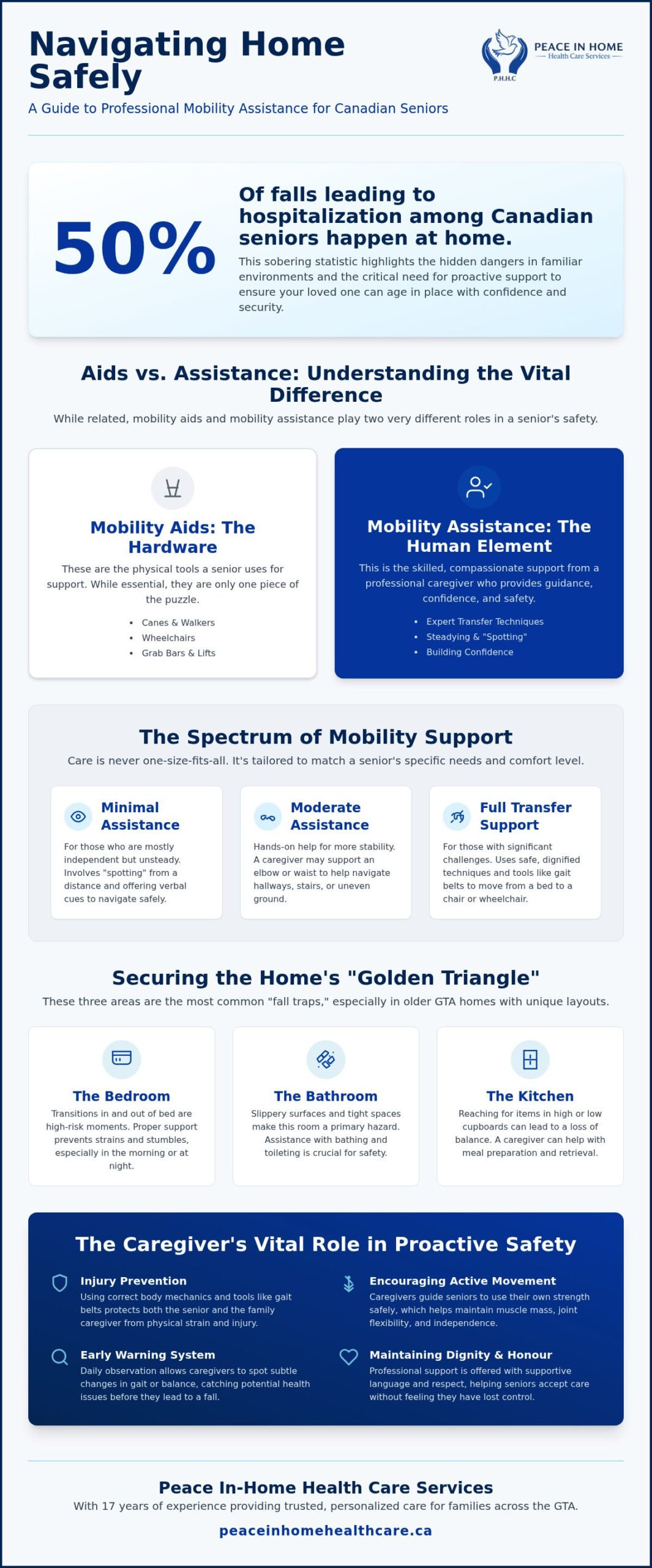
Did you know that 50% of falls leading to hospitalization among Canadian seniors happen right in the comfort of their own homes? It’s a sobering reality for families across the GTA who are trying to balance their loved one’s desire for independence with the very real fear of a life-changing injury. You likely feel the weight of this responsibility every day, perhaps even experiencing physical strain from helping a parent stand or the heavy guilt of not being able to watch over them every hour. It’s a difficult position to be in, but you don’t have to carry this burden alone.
We understand that maintaining dignity is just as important as physical safety. This guide will show you how tailored mobility assistance for seniors at home can transform a high-risk environment into a sanctuary of support. You’ll learn professional techniques to prevent dangerous falls, discover how specialized caregivers can relieve family stress, and explore Canadian financial resources like the Home Accessibility Tax Credit. By the end of this article, you’ll have a clear, compassionate roadmap to help your loved one age in place with the security and confidence they deserve.
Key Takeaways
- Understand the vital difference between simple mobility equipment and the compassionate human support needed to navigate the home safely.
- Learn professional transfer techniques that prevent injuries and reduce the physical and emotional strain on family caregivers.
- Identify hidden “fall traps” in GTA homes and apply the “Golden Triangle” strategy to secure the bedroom, bathroom, and kitchen.
- Discover how dignified mobility assistance for seniors at home uses supportive language to help your loved one accept care without feeling like they’ve lost their independence.
- See how a personalized care plan from a trusted provider with 17 years of experience can adapt as your family’s needs change over time.
What is Mobility Assistance for Seniors at Home?
When families first notice a parent struggling to stand or walk, they often look for a cane or a walker. While these tools are helpful, true mobility assistance for seniors at home is much broader than just equipment. It’s a thoughtful combination of professional physical support and environmental adjustments designed to keep your loved one safe. Think of it as a partnership where a caregiver provides the steady hand and expert guidance needed to navigate daily life without the constant fear of a fall.
There’s a significant difference between mobility aids and mobility assistance. Aids are the hardware, such as walkers or wheelchairs, which fall under the category of Assistive technology. Assistance, however, is the human element. A caregiver understands how to time a movement, how to brace for a transition, and how to encourage a senior to use their own strength safely. This human connection builds confidence that a piece of metal simply cannot provide.
For many in the GTA, mobility is the cornerstone of aging in place. When a senior can move freely, their world remains open. They can reach the garden, enjoy a meal in the kitchen, or move to a favourite chair by the window. This physical freedom is directly linked to mental well-being. Losing the ability to move often leads to isolation; maintaining it preserves a senior’s sense of self and emotional health.
The Spectrum of Mobility Support
Every senior has unique needs, and support should be tailored to match their specific level of comfort. Minimal assistance often involves “spotting” or providing verbal cues for those who are mostly independent but feel a bit unsteady. Moderate assistance moves into hands-on help, where a caregiver might support an elbow or waist while navigating hallways or single steps. For those with more significant challenges, full transfer support uses safe, dignified techniques to help a person move from a bed to a chair or a wheelchair, ensuring no one is injured in the process.
Why GTA Families are Choosing In-Home Support
Many Toronto families live in beautiful, older semi-detached homes that feature steep stairs and narrow corridors. These layouts can become “fall traps” as we age. Choosing in-home support allows families to avoid the institutional feel of long-term care facilities while managing these environmental risks. Integrating personal care assistance for seniors into a daily routine ensures that your loved one stays in the home they love, surrounded by their own memories, with the professional oversight needed to stay safe.
The Human Element: How Caregivers Provide Mobility Support
While grab bars and walkers are essential tools, they’re only part of the solution. The true heart of mobility assistance for seniors at home lies in the skilled presence of a caregiver. Professional support isn’t just about lifting a person; it’s about using specific, evidence-based techniques that protect both the senior’s dignity and the caregiver’s physical safety. This human connection turns a potentially frightening transition into a routine moment of trust.
A key philosophy in modern care is encouraging active movement. Instead of simply doing everything for a senior, a caregiver guides them to use their own muscle strength whenever possible. This approach helps maintain joint flexibility and prevents the rapid muscle atrophy that can occur when a person stops moving independently. Whether it’s a steady hand during a morning walk or assistance getting in and out of a car for a doctor’s visit, every interaction is an opportunity to reinforce confidence. If you’re feeling overwhelmed by these daily physical demands, you can always speak with a care coordinator to see how a professional can help.
Caregivers also act as an early warning system. By closely observing a senior’s daily routine, they can spot subtle changes in gait or balance that might otherwise go unnoticed. These shifts often indicate a new health issue or a medication side effect. Catching these signs early is a vital part of Growing Older at Home safely, as it allows for proactive adjustments before a fall occurs.
Transfer Assistance and Fall Prevention
Safe movement often requires specialized knowledge of body mechanics. Caregivers use non-medical tools like gait belts to provide a secure point of contact without pulling on a senior’s arms or clothing. For those with limited leg strength, pivot transfers allow for a safe move from a bed to a chair with minimal strain. This level of attentiveness is especially crucial in the kitchen or bathroom, where moisture on the floor can create immediate hazards.
Companionship During Movement
The fear of falling is often the biggest barrier to staying active. When a senior has a reliable partner by their side, that anxiety begins to fade. Movement becomes less of a chore and more of a social experience. By integrating companionship care for seniors in Toronto, caregivers can turn a simple walk around the block into an engaging conversation. This social stimulation, combined with light exercise, keeps both the mind and body resilient.
Safety Strategies for the Canadian Home Environment
Many GTA homes, especially the beautiful Victorian semis in neighbourhoods like the Annex or High Park, feature narrow hallways and steep, winding staircases. While these architectural details add character, they often become significant hazards as mobility changes. Identifying these “fall traps” is the first step in creating a secure environment. Beyond the stairs, loose area rugs and high door sills are common culprits that can catch a toe and lead to a dangerous stumble. Creating a safe space isn’t always about a major renovation; it’s about realizing a layout that respects the senior’s daily patterns.
We focus on what we call the “Golden Triangle” of home safety: the bedroom, the bathroom, and the kitchen. Most daily activity and, unfortunately, most accidents happen within these three zones. Ensuring a clear, wide path between the bed and the washroom is essential. Lighting also plays a silent but vital role in prevention. Installing motion-sensor nightlights along hallways and in the bathroom can prevent the disorientation that frequently leads to nighttime falls. When combined with professional mobility assistance for seniors at home, these environmental tweaks create a comprehensive safety net.
Essential Home Modifications
Simple, high-impact changes can often be completed in a single afternoon. Grab bars are a priority, but they must be installed in the centre of the bathroom wall or near the shower entry to provide a truly stable anchor point. Tripping hazards should be cleared away immediately. This includes securing loose electrical cords, removing decorative mats, and clearing clutter from high-traffic zones. For those wooden stairs common in older Toronto homes, adding transparent non-slip treads provides essential grip without masking the home’s original aesthetic. These small adjustments ensure the house remains a home rather than feeling like a clinical facility.
Leveraging Assistive Technology
When hardware is required to support movement, Ontario families can often access financial help. The Ontario Assistive Devices Program (ADP) is a valuable resource, typically covering 75% of the cost for eligible equipment like custom-fitted walkers or manual wheelchairs. Selecting the right tool depends on where it will be used. A standard walker provides excellent indoor stability, while a rollator with wheels and a built-in seat is often better for those who enjoy walking to a local park or community centre. If the second floor becomes inaccessible, families might need to weigh the benefits of a stairlift against the practical step of moving the senior’s bedroom to the main floor to maintain their independence.
Maintaining Dignity: Overcoming Resistance to Assistance
Admitting that you need a hand to walk across the room is one of the hardest transitions a person can face. For many seniors, accepting mobility assistance for seniors at home feels like more than just a physical change; it feels like a loss of the “self.” It’s not just about the fear of falling. It’s the fear that they’re becoming a burden or losing the final threads of their independence. Understanding this emotional hurdle is essential for any family trying to keep a parent safe in the home they love.
The language we use can change the entire experience for a senior. Instead of talking about “supervision” or “help,” try using terms like “partnership” or “support.” This subtle shift positions the caregiver as a teammate rather than an authority figure. When a senior feels they’re in a partnership, they’re much more likely to accept the professional guidance of a home care agency in Toronto. A consistent, familiar face creates a bond of trust that makes the presence of a caregiver feel like a natural part of the day rather than an intrusion. We’ve seen that when a caregiver becomes a friend, the resistance to physical support often melts away.
The ‘Dignity First’ Approach
Dignity comes from having a say in your own life. We encourage families to let their loved ones make choices about their movement and daily schedule whenever possible. Focus on what they can still do. If they can still navigate the kitchen with a walker but need help with the stairs, honour that independence. Caregivers should act as patient guides, offering a steady hand only when it’s truly needed. This approach ensures that mobility assistance for seniors at home feels like a tool for empowerment that actually increases their freedom to move around the house safely.
Handling the ‘I Can Do It Myself’ Phase
It’s common for seniors to assert their independence even when it becomes a safety hazard. When pride starts to lead to near-misses, it’s time to introduce support gently. One effective method is using “errand accompaniment.” Framing the support as having someone to help carry groceries or navigate busy Toronto streets makes it feel less like medical care and more like a helpful service. Eventually, transitioning from family-led care to professional support can actually preserve the parent-child relationship. It allows you to go back to being the daughter or son, while a trained professional handles the complex physical needs.
Peace In-Home Health Care: Your GTA Mobility Partners
For over 17 years, Peace In-Home Health Care Services has been a steady, reliable presence for families across the Greater Toronto Area. We’ve seen first-hand how the right support can turn a house full of hazards into a sanctuary of comfort and safety. Our team provides specialized mobility assistance for seniors at home, ensuring that your loved one stays safe while maintaining the lifestyle they’ve spent decades building. Whether you’re in the heart of Toronto, Vaughan, Mississauga, or Markham, our local knowledge of GTA home layouts allows us to provide targeted, effective care that respects the unique character of your neighbourhood.
We recognize that mobility needs often intersect with more complex health conditions. For those recovering from surgery or managing chronic illnesses, we offer skilled nursing care at home in Toronto. This integration ensures that physical movement is always supported by clinical expertise, providing a comprehensive safety net that evolves as your family’s needs change. It’s about more than just moving from room to room; it’s about moving with confidence and the reassurance of medical oversight. We’re here to stand alongside you as a trusted guide through every stage of the aging journey.
Our Caregiver Training and Standards
Safety is our absolute priority, and it starts with our people. Every caregiver undergoes a rigorous screening process and specific training in safe transfer and lifting techniques. We don’t just focus on the physical mechanics of movement. We prioritize emotional intelligence and empathetic communication. Our team is taught to listen, to be patient, and to respect the dignity of the person they’re supporting. Continuous monitoring and regular check-ins ensure that we always meet the high standards your family deserves, providing a level of care that’s as compassionate as it is professional.
Getting Started with a Safety Assessment
The first step toward peace of mind is understanding the specific challenges of your home environment. We begin with a thorough initial evaluation of the physical space and your loved one’s current mobility levels. This assessment helps us match your family with the right caregiver, someone who understands your home’s layout and your parent’s unique personality. We’re here to help you navigate this transition with ease and quiet confidence. You can book a free consultation for mobility assistance today to start building a safer, more independent future for your loved one.
Empowering Your Loved One to Age with Confidence
Aging in place is a beautiful goal that requires a proactive plan. By identifying hidden fall traps in your home and embracing the human element of care, you can create an environment where your loved one thrives. True mobility assistance for seniors at home isn’t about restriction; it’s about providing the steady hand needed to maintain a familiar lifestyle and a cherished sense of independence. When safety and dignity are prioritized together, the home remains a place of joy rather than a source of anxiety.
Peace In-Home Health Care brings nearly two decades of trusted experience to families across the GTA. Our fully insured and bonded caregivers are more than just professionals; they’re compassionate partners dedicated to protecting the dignity of every senior we serve. We’ve spent over 17 years helping families in Toronto, Vaughan, and Mississauga find the perfect balance between professional support and personal freedom.
You don’t have to navigate these complex transitions alone. Let us help you turn uncertainty into peace of mind, ensuring your home remains the safe, happy place it was always meant to be. We’re ready to guide your family toward a more secure future today.
Frequently Asked Questions
What is the difference between a walker and a rollator for home use?
A standard walker is a stable, four-legged frame that the user must lift to move forward, providing maximum support for those with significant balance issues. A rollator features wheels, hand brakes, and often a built-in seat for resting. While rollators are excellent for maintaining a steady walking pace, walkers are usually safer for individuals who need to lean heavily on the frame for stability while navigating their home.
Does the Ontario government pay for mobility assistance at home?
The Ontario government provides financial help for equipment through the Assistive Devices Program (ADP), which typically covers 75% of the cost for walkers and wheelchairs. For the human support side of mobility assistance for seniors at home, families can often claim the Medical Expense Tax Credit (METC) or utilize the Home Accessibility Tax Credit (HATC) to offset the costs of making a residence safer and more accessible for a loved one.
How can I tell if my parent’s balance is getting worse?
Watch for “furniture walking,” where your parent touches walls or tables for stability while moving through the house. Other signs include difficulty standing up from a low sofa, a wider gait, or hesitation when stepping onto different floor textures. If they seem to be looking at their feet more often while walking, it’s a clear signal that their confidence in their balance is wavering and they may need additional support.
Is mobility assistance included in standard personal care services?
Mobility and transfer support is a fundamental part of our personal care assistance. Our caregivers are trained to integrate movement help into every part of the day, from morning dressing to evening routines. This ensures that transitions between the bed, chair, and washroom are handled with professional techniques that protect your loved one’s safety and preserve their physical dignity throughout their daily life at home.
Can a caregiver help with exercises to improve my parent’s mobility?
While our caregivers are not physiotherapists, they play a vital role in supporting the exercise plans provided by your medical team. We provide a steady hand and gentle encouragement to help your parent complete their daily stretches or walks. This consistent support helps maintain muscle strength and joint flexibility, which are essential for preventing falls and staying independent in the home they love.
What should I do if my parent refuses to use a mobility aid?
It’s best to start by listening to their fears, as resistance often stems from a worry about losing their identity. Try reframing the aid as a “tool for freedom” that allows them to visit the park or garden safely. Sometimes, having a professional caregiver introduce the aid as part of a supportive partnership feels less like a loss of independence than a family member’s suggestion might.
How do I make a Toronto home with narrow stairs safer for a senior?
For the narrow staircases common in Toronto’s older semi-detached homes, start by installing high-contrast, non-slip treads on every step. Ensure the lighting is bright and motion-activated to prevent trips in the dark. If the stairs become too difficult, we can help you reorganize the home’s layout to create a “main-floor living” plan that keeps everything your parent needs on one level for their safety.
Are your caregivers trained in specialized dementia transfer techniques?
Our caregivers receive specialized training in dementia and Alzheimer’s care, focusing on the unique communication needs of these clients. We use gentle, low-stress transfer techniques that prioritize the senior’s emotional comfort. By maintaining a calm environment and using clear, simple cues, we ensure that mobility assistance for seniors at home is a dignified and safe experience for those living with cognitive challenges.